
If you were to ask me what BPD recovery looks like, I could only speak to my personal experience of recovery.
I have to admit, reading back through this post from almost 2 years ago on my recovery journey, it strikes me how far I have come in that time. It stings a little and I still notice a hint of shame, but I’m so glad it exists.
Since I first wrote this blog, I have:
- Completed a year’s course of intensive DBT (Dialectical Behaviour Therapy) – 3 hours a week
- Ended the destructive relationship I was in and cut the last cord to my old drinking life
- Spent 6 months alone and completely focused on my recovery (my traumatized body needed rest!)
- Met my now-fiance and began the most beautiful romance of my life.
Oh – and I’m going to be a step-mama. 💗 So you could say a little has changed.
That is the beauty – and importance – of BPD recovery stories. The loud statement that we absolutely can recover. All of the bulls*t stigma we are bombarded with in the face of diagnosis, or just living with BPD, is just that: stigma.
We know there’s a strong link between complex trauma and BPD diagnoses. If we can see this in ourselves without judgment, and start building a trauma-informed life, BPD is in no way a life sentence.
Yes, I am still an “emotional” person – but I know what to do with those beautiful emotions now, and how to separate myself from them. How to observe them and respond from a place of Wise Mind, as opposed to reacting in self-destructive ways. I am 500 days self-h*rm free, 29 months booze-free. And I don’t remember the last time I even felt an urge to hurt myself.
It has absolutely taken work. To validate yourself through the journey of recovery is one of the hardest parts. But if I can pass on one thing with my recovery stories, it’s this:
You are absolutely worth your recovery.
You don’t need to justify your recovery to anybody. Make it the priority of your life. Set boundaries. Know that if you are exhausted from years of complex trauma your body might need to rest and shutdown for a period of time. Allow it. Don’t shame yourself. You will come out of the other side – and you will feel human again. You can experience happiness as a baseline in your life. It is absolutely possible and absolutely worth every painful challenge along the way.
Keep going.
You Might Like: The Little Guide To DBT Mindfulness Skills
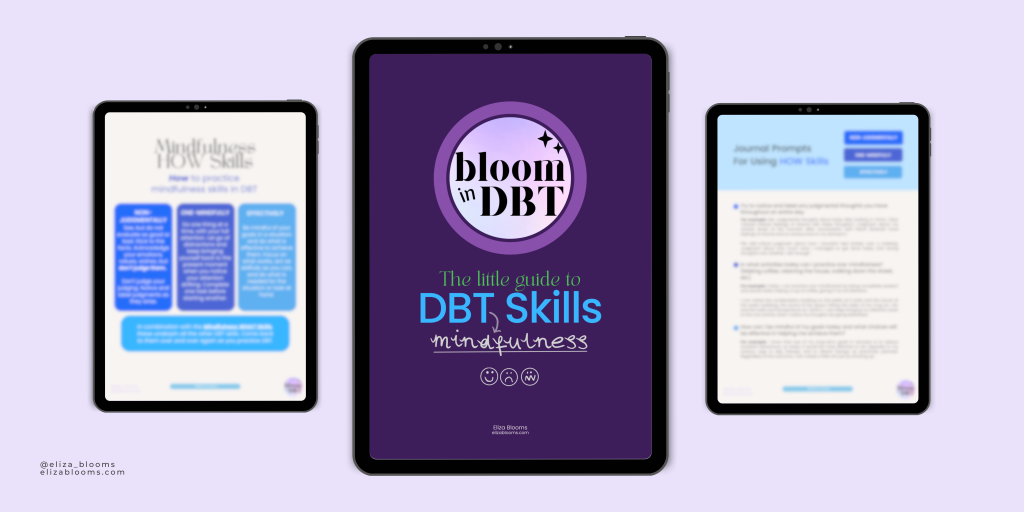
This 30 page digital e-book includes:
- 6 DBT Mindfulness Skill Graphics with easy-to-understand visual designs that help you remember them.
- 20+ Mindfulness Skill Journal Prompts with my own real-life example journal entries for each skill.
- Full page journal templates to help you easily combine and learn how to use the skills.
- Personal insights from someone who truly had their life saved by DBT – and how I went from zero DBT skills to daily skills use.
Available for instant download now


 Eliza Blooms
I know it’s over a month since you posted this, but I want to say thank you for the encouragement.
LikeLiked by 1 person
Thank you so much lovely. It really does get better. Sending so much love!
LikeLike
“Spent 6 months alone and completely focused on my recovery (my traumatized body needed rest!)” – okay, so were you able to get out of working while doing this? I did a post not long ago where I was considering committing myself to either a spiritual institution or mental institution or something that would allow me to focus on just the trauma work and not have to deal with work stress / politics for like 6 months. So I’m curious how you went about that. Anyway liked the post and enjoying the blog.
LikeLike
Also I just read the first part and you’re very articulate about the day to day experience of it. That’s refreshing. I write about these things and it goes into a void where other people don’t really get it. But you articulate the experience in that first post.
LikeLike