

Starting a mindfulness practice might feel daunting at first. Often, too much focus is put on the complex meditative practices that can be associated with mindfulness. People imagine they need to be sat in the full lotus, chanting their mantras with a completely clear and laser-focused mind. But let’s strip away these misconceptions and get back to the essence of mindfulness.
At its core, mindfulness is refreshingly simple. It’s about embracing the present moment and nurturing awareness without judgement. You don’t need to be in a special place or adopt intricate meditation techniques. Mindfulness is accessible to everyone, anytime, anywhere.
In this article, I want to delve into a straightforward mindfulness practice that takes just five minutes or less. It’s designed to be approachable for beginners and seasoned practitioners alike, offering a practical way to integrate mindfulness into your daily life.
So, let’s explore how you can begin to tap into the power of mindfulness, one day at a time.
What is Mindfulness?
Mindfulness involves paying attention to the present moment, intentionally and without judgement. It’s about observing thoughts, emotions, and sensations as they arise, without getting caught up or lost in them.
Originally rooted in ancient Buddhist traditions, mindfulness has gained popularity in modern therapeutic approaches like Dialectical Behavior Therapy (DBT) for its effectiveness in reducing stress and promoting emotional well-being.
The quick practice that I will outline below ties together a few of the key DBT Mindfulness Skills, offering a simple introduction to the core principles of DBT and how you can practically apply them in your own life.

Benefits of a Quick Consistent Mindfulness Practice
Engaging in a simple mindfulness practice regularly can yield numerous benefits, including reduced stress, improved focus, and greater emotional resilience. By taking just a few minutes each day to cultivate mindfulness, we can enhance our overall well-being and experience a greater sense of peace and contentment in our lives.
From a mental health or emotional dysregulation perspective, here are a few benefits I have experienced from this regular practice:
- Decreased ongoing distress levels and a greater ability to manage stressors effectively.
- Improved emotional regulation skills and a heightened sense of emotional stability.
- Enhanced self-awareness and a greater capacity for self-compassion, acceptance and self-respect.
As for simplicity, a quick and simple practice can help combat the overwhelm attached to complex mindfulness or meditation techniques that can feel overwhelming and impractical for everyday life.
By simplifying the practice, we make it more accessible and easier to incorporate into our daily routines. Especially considering that short and simple practices can be just as effective in promoting mindfulness as longer, more elaborate ones.
Simple Mindfulness Practice in 4 Steps
The simple mindfulness practice we’ll explore is based on the principles of DBT. It consists of four straightforward steps.
Step 1: Observe
Take a moment to notice what’s happening in your environment and within yourself. Pay attention to your thoughts, feelings, and physical sensations without trying to change them. Pay attention to all of your senses, observing the sounds, colours, tastes you can sense without assigning interpretations or meaning to them.
As one of the core DBT Mindfulness WHAT Skills, the Observe skill helps us cultivate awareness of the present moment as it is, acknowledging whatever arises without judgement or resistance; or additionally observing any judgement or resistance as it arises.
The key is to approach observation with a curious and open mindset, allowing yourself to simply be with whatever you are currently experiencing. By developing the skill of observation, you can increase your capacity to respond skillfully to challenging situations and cultivate a greater sense of inner calm and clarity.
Step 2: Describe
Verbalise, mentally note or journal what you’re observing. Use objective language to describe your experiences without adding your own interpretations or judgments.
This step involves bringing mindful awareness to your inner and outer experiences and articulating them with clarity and precision, and is the second of the three DBT Mindfulness WHAT Skills.
When describing your observations, focus on the facts rather than your interpretations or opinions. For example, instead of saying, “I am anxious,” you might say, “I notice tightness in my chest and racing thoughts, which tells me I am experiencing the emotion of anxiety.”
By describing your experiences in this way, you create distance between yourself and the thoughts and emotions you’re experiencing, allowing you to observe them more objectively and make more effective decisions on how to move forward.
Step 3: Identify Judgments & Assumptions
Notice any judgments or assumptions that arise as you observe and describe. Instead of getting caught up in them, simply acknowledge their presence and let them pass.
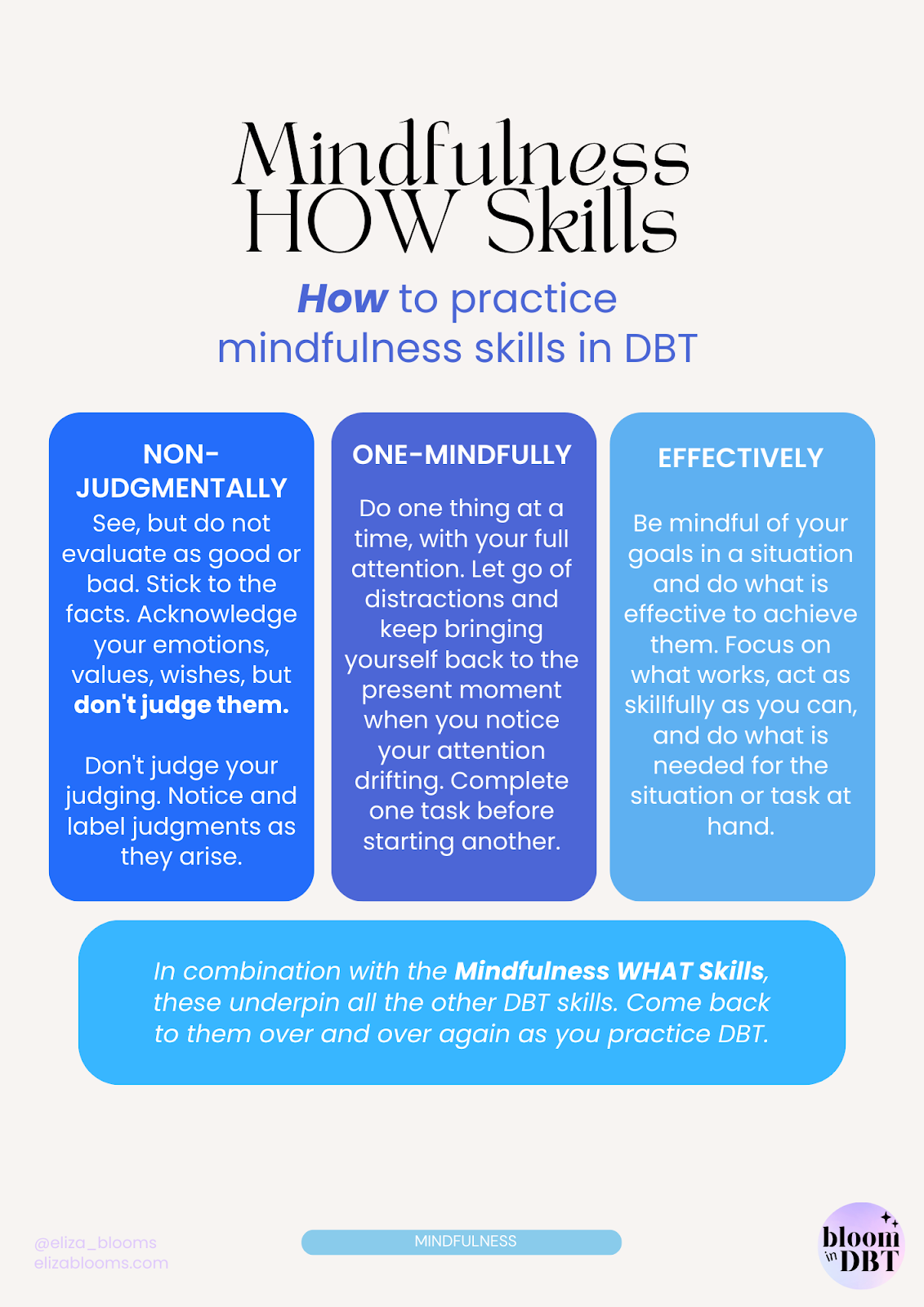
This practice of ‘Non-judgmentalness’ is taught as a part of the Mindfulness ‘HOW’ Skills in DBT. This step involves developing awareness of the automatic thoughts and beliefs that shape your perceptions and reactions to the world around you.
As you engage in this practice, you may notice a tendency to label experiences as “good” or “bad,” “right” or “wrong.” These judgments can cloud your ability to see things as they are and create unnecessary suffering. By identifying and letting go of these judgments, you create space for greater clarity and acceptance.
One helpful technique for working with judgments is to label them as such when they arise. This is also known as a meditation technique called ‘Noting’. For example, if you notice yourself thinking, “This is terrible,” you might silently say to yourself, “Judgement.”
This simple act of factually describing can help you disengage from the judgement and return to a place of open-minded observation.
Step 4: Mindfully Assess Most Effective Actions
Based on your observations, consider how you can respond mindfully to the present moment. Choose actions that align with your values, long-term goals and promote well-being.
This practice of ‘Effectiveness’ is also taught as a part of the Mindfulness ‘HOW’ Skills in DBT. This step involves applying the insights gained through observation, description, and non-judgment to inform your decision-making and behaviour.
As you assess the most effective actions to take, consider what will serve your highest good and the good of others in the situation. This may involve setting boundaries, expressing your needs and feelings assertively, or simply pausing before reacting impulsively.
By bringing mindful awareness to your actions, you can break free from habitual patterns and respond to life’s challenges with greater wisdom and compassion.
One helpful practice for cultivating mindful action is to pause and check in with yourself before responding to a situation.
Ask yourself, “What would be the most skillful and effective response at this moment?” Take a few deep breaths and listen to your inner guidance. Trust that you have the wisdom and resources within you to navigate life’s challenges with grace and resilience.
Applying this Quick Practice in Everyday Life
This simple mindfulness activity can be applied in various situations, from moments of stress or anxiety to everyday activities like eating or walking. For example:
- When feeling overwhelmed by stress, take a few minutes to observe your thoughts and emotions without judgement or acting on any urges observed.
- During a meal, pay attention to the taste, texture, and sensations of each bite, savouring the experience without distraction.
- While walking, focus on the sensation of each step and the sights and sounds around you, grounding yourself in the present moment.
Conclusion
In a world filled with distractions and demands, practising mindfulness really doesn’t have to be complicated. By embracing simplicity and incorporating short, straightforward practices into our daily routines, we can reap the benefits of mindfulness without adding unnecessary complexity.
Give the simple mindfulness practice outlined in this article a try, and see how it can begin to transform your life in just five minutes or less.
Get instant access to 20+ mindfulness journal prompts, templates, plus real example DBT skill journal entries in my Little Guide to DBT Mindfulness Skills. Available for download today.

 Eliza Blooms
3 thoughts on “A Simple Mindfulness Practice (5 Minutes or Less)”