

When I put this together, I first started writing a post about what shame does for us, and quickly realised that I still sometimes struggle to differentiate between what is shame and what is guilt. This “blur” of emotions can happen for a number of reasons, one being complex trauma.
So I thought I’d run through some of DBT Emotional Regulation handout (6) that teaches us ways to describe different emotions and has some really useful identifiers for both guilt and shame.
Guilt vs shame: the key differences
The main differences between shame and guilt can be easily broken down into three categories:
- The prompting events for the emotion
- The biological changes and experience of the emotion
- The expressions and action urges associated with the emotion
In the sections below, I’ll compare each of these factors for both guilt and shame, highlighting the key differences to help you identify which emotion you are really feeling if, like me, you’re not quite sure.
1: The prompting events
Prompting events are the situations, thoughts, or memories that trigger an emotional response. They can be external, like someone criticising you, or internal, like remembering a past mistake. Understanding what prompted your emotion can be a useful guide when identifying it.
Prompting events for feeling guilt:
- Doing or thinking something that goes against your personal values.
- Doing or thinking something you believe is wrong.
- Not doing something you said you would do.
- Causing harm/damage to another person or object.
- Causing harm/damage to yourself.
- Being reminded about something you did wrong in the past.
Prompting events for feeling shame:
- Doing (or feeling or thinking) something that people you admire think is wrong.
- Being rejected by people you care about.
- Having others find out that you have done something wrong.
- Being laughed at, made fun of, or criticised in public.
- Being rejected or criticised for something you expected praise for.
- Having emotions/experiences that have been invalidated.
- Exposure of a very private aspect of yourself or your life.
- Being reminded of something wrong or “shameful” you did in the past.
2: Biological changes and experiences
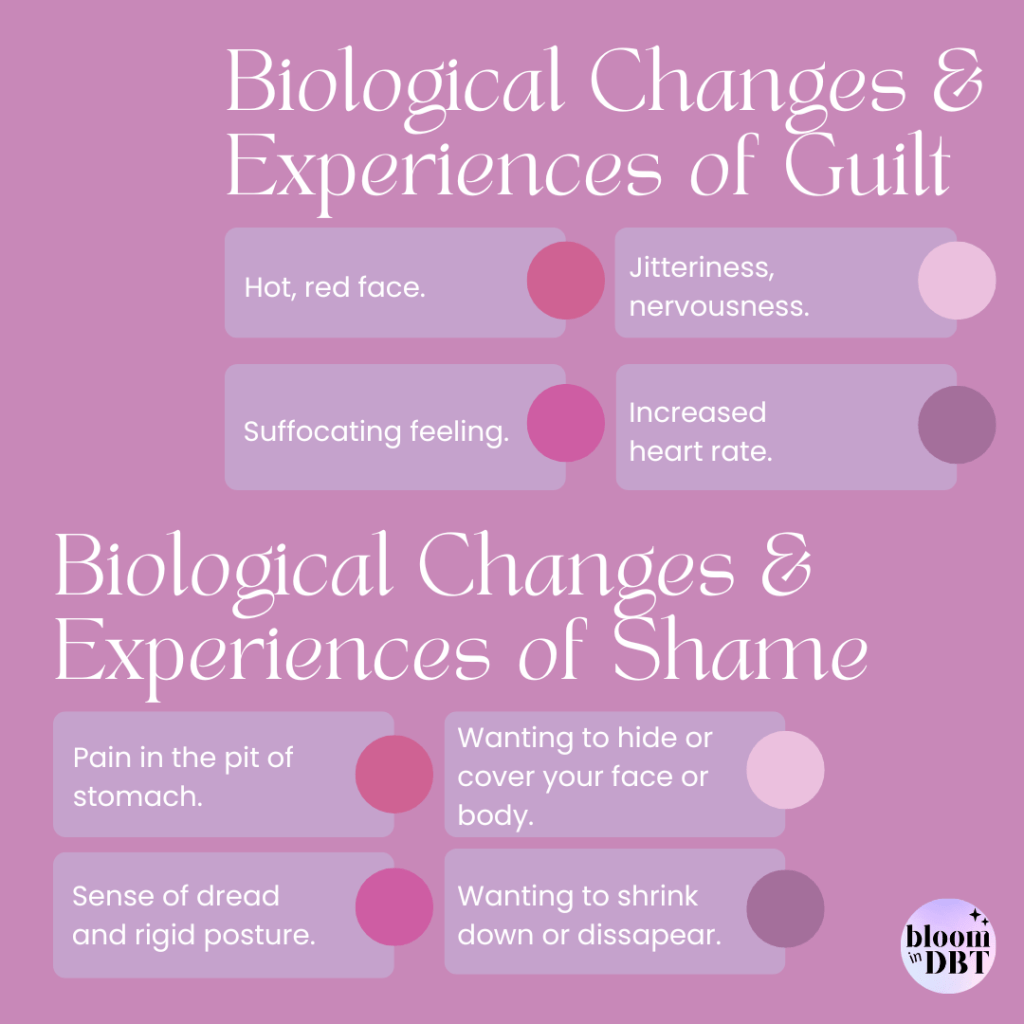
Biological changes and experiences refer to the physical sensations and internal body responses we feel when we experience an emotion.This might include changes in heart rate, muscle tension, body temperature, or posture. Noticing these cues can help us identify what we’re feeling, even before we find the words for it.
Biological changes and experiences of guilt:
- Suffocating feeling.
- Hot, red face.
- Jitteriness, nervousness.
- Increased heart rate.
Biological changes and experiences of shame:
- Sense of dread and rigid posture.
- Pain in the pit of the stomach.
- Wanting to hide or cover your face or body.
- Wanting to shrink down or disappear.
3: Expressions and action urges
Expressions and action urges are the outward behaviours and impulses we feel driven to do in response to an emotion. For example, you might feel an urge to apologise when you feel guilty, or hide when you feel ashamed. Being aware of these urges helps us choose whether to act on them or use skills to respond differently.
Expressions and action urges of guilt:
- Making sacrifices to try and make up for harm done.
- Trying to repair or make amends.
- Apologising, asking for forgiveness.
- Lowering your head/kneeling.
Expressions and action urges of shame:
- Avoiding others you have harmed or who criticise you.
- Hiding behaviours or characteristics from others.
- Appeasing, saying sorry over and over
- Looking down or away from others; withdrawing.

When emotional lines get blurred…
I think due to the nature of shame and its connection to others outside of ourselves, it serves the purpose of helping us meet our intrinsic need for connection. It protects us by trying to avoid any future rejection from social groups or people we admire, while guilt urges us to make repairs and change our future actions.
For people with a history of complex trauma, it might be hard to differentiate between what is our fear of the opinions of others, and what we really believe is right and wrong. Shame might blur into guilt, and vice versa. DBT helps us learn more effective ways to identify our emotions and manage them healthily.
Mindfulness and labeling emotions
One of the most powerful tools for untangling shame from guilt is mindfulness. When we can pause, turn inward, and notice our emotional experience without judgment, that’s when real change starts. DBT Mindfulness teaches us to:
- Observe what we’re feeling
- Label it accurately
- Stay present, without spiralling or pushing the emotion away
It’s the foundation of every other DBT skill, including emotion regulation. If you’re not sure where to begin, my Little Guide to DBT Mindfulness Skills eBook is a gentle, practical place to start, and it’s available for instant download now.
Remember, you are not wrong or broken for feeling confused. Emotions can be messy. You’re human, you’re healing, and it makes sense that the lines feel blurry sometimes.
With love,
Lizzie 🤍

 Eliza Blooms
1 thought on “Can you tell the difference between guilt and shame?”