
“Tink was not all bad: or, rather, she was all bad just now, but, on the other hand, sometimes she was all good. Fairies have to be one thing or the other, because being so small they unfortunately have room for one feeling only at a time. They are, however, allowed to change, only it must be a complete change.”
― J M Barrie, Peter Pan
I just came across this quote while watching a video about fairy mythology, and felt on some level a deep connection to this description of Tinker Bell.
At the same time, Tink through this lens definitely feels like an allegory for emotional splitting, which is, coincidentally, something I have had plenty of experience with over the years.
In more recent years, this tends to apply to me less, as I’ve worked hard to feel much more integrated with my emotions and able to hold contradicting emotions; but I still feel this old way of being bubbling sometimes, and might always, you know?
I was going to make a social post, but the quote itself doesn’t do my thought process justice. So here we go.
What is emotional splitting and why does Tink sum it up so well?
If you’re here, you might already have some experience with splitting, but for the newbies, emotional splitting is a kind of all‑or‑nothing emotional processing where a person can’t hold mixed or ambivalent feelings about someone (or themselves).
Instead, they might flip between “all good” and “all bad” states of emotion, or, more clinically-speaking, rapidly move between idealisation (“you’re perfect, I love you”) and devaluation (“you’re terrible, I hate you”), either towards others or internally, towards ones self.
The quoted description of Tink sums this up almost too perfectly. And her character arc certainly displays this emotional splitting cycle well, if to a certain extreme:
- In Tink’s devaluation phase: She is totally “in” her hatred and jealousy, with no access to empathy or nuance.
- In Tink’s idealisation phase: She is wholly “in” her adoration and self‑sacrifice, with no access to hurt or anger.
There is no in-between.
For us real-life fairies trying our best to regulate our emotions, navigating the extremes of them can feel like riding a literal rollercoaster. The punch in the gut of devaluation; the elation of idealisation.
At the same time, there are ways to move past the two extremes into a more dialectical (integrated) way of being. More on dialectics later.
Good and bad emotions
One way to challenge the logic that drives splitting in the first place is through our emotional labelling, because “Good” and “Bad” emotions don’t actually exist.
Yes, there is a real distinction between emotions that feel pleasant and those that feel unpleasant; and even more critically, between emotions that feel safe and those that feel unsafe.
But when our internal labelling system turns this into a moral verdict or a catch-all “good” or “bad”, it encourages the same all‑or‑nothing patterns of the idealisation and devaluation cycle.
For example:
- “I feel joy → joy is good → I am good / they are good.”
- “I feel anger → anger is bad → I am bad / they are bad.”
This is exactly how a feeling turns into a split: if the emotion is “good,” the self or other must be all good; if the emotion is “bad,” the self or other must be all bad.
Remember, these are not factual statements. They are myths.
A challenge to these myths is that emotions are not “good” or “bad”, they just are.
And we can’t do anything to help ourselves through strong emotions effectively if we invalidate them by labelling them as bad, or treat them as proof that we are (or someone else is!) fundamentally good or fundamentally terrible.
To challenge your own myths, you can map your them out non‑judgmentally and fact‑check them like I did above:
- I feel [feeling] → [feeling] is [good/bad] → I am / they are [good/bad].
Once you see that chain, it becomes much easier to notice where you might be slipping into that Tink‑style emotional splitting loop.
My Tinker Bell era
For me, I definitely experienced more outward idealisation/devaluation phases like this frequently when I was still drinking and untreated for my mental health, especially throughout toxic relationships.
I also feel a great connection to the description of:
“They are, however, allowed to change, only it must be a complete change.”
I feel like this summarises the first 25 years of my life, which felt like one long identity crisis after another. I would suddenly hate every past version of myself and completely shift in how I presented myself to the world, my interests and ideals, with no idea who I really was.
I have a much better grip on this now that I realise I can be so many things all at once, and ebb and flow between them without them shaping my entire identity.
Now, splitting tends to slip in more about how I feel towards myself and my inner voice. If I’m doing X, Y and Z, I am great and everything is great. If one thing slips, I am terrible and the worst human on the planet.
It’s not quite so intense anymore, with much more grey area, but it still takes conscious skill usage to get me there sometimes.
I have to pause and check myself on facts and judgments, but the difference is that I can do that now, whereas my own emotional myths felt so factual and uncontrollable before.
Do we have to be one thing or the other? (Dialectics)
While my inner Tink wants to love the quote we started with in a romanticised way, I can see the relatability of that quote and still hold close that I don’t have to siloe my emotions like that anymore.
The truth is, the emotional spectrum is richer than any single, totalising state, which is one of the many things DBT taught me. Emotions really do come in, sometimes contradictory, nuanced and complex, waves.
Dialectical Behaviour Therapy, or DBT, is directly built around the concept of dialectics and the dialectical approach, which means learning to hold two seemingly opposite or contradictory truths at the same time.
This is why DBT is so useful for people that struggle to regulate their emotions and experience emotional splitting, which can be particularly common in those of us living with BPD and cPTSD.
The approach starts from the premise that we nearly always experience multiple emotions, thoughts, and urges at once, often in conflict. For example, “I love you and I’m furious with you”, or experiencing valid emotions at the same time as unhelpful urges.
DBT treats this complexity as:
- Biologically normal, not a flaw.
- Something that can be understood, named, and regulated rather than simplified away into “all good” or “all bad.”
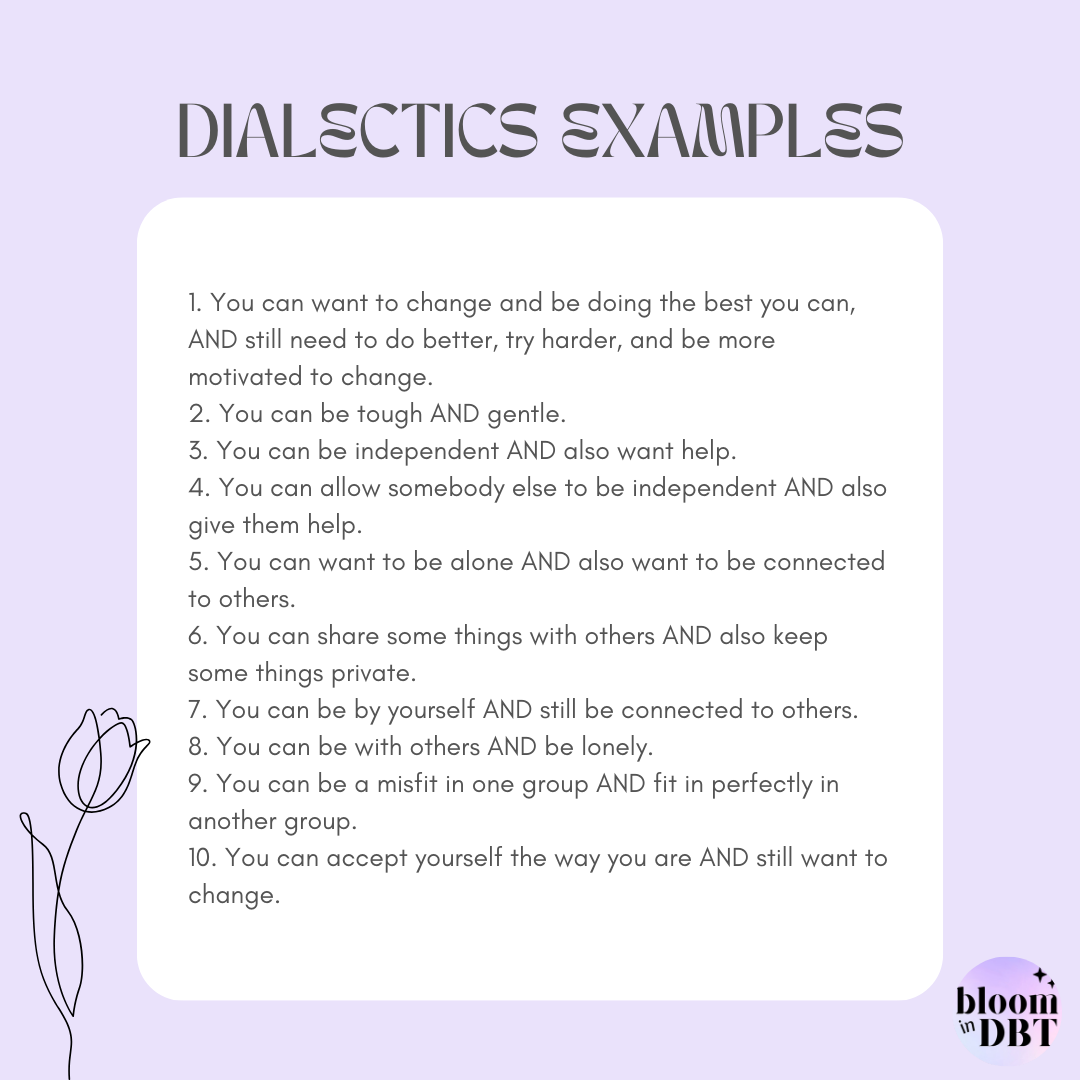
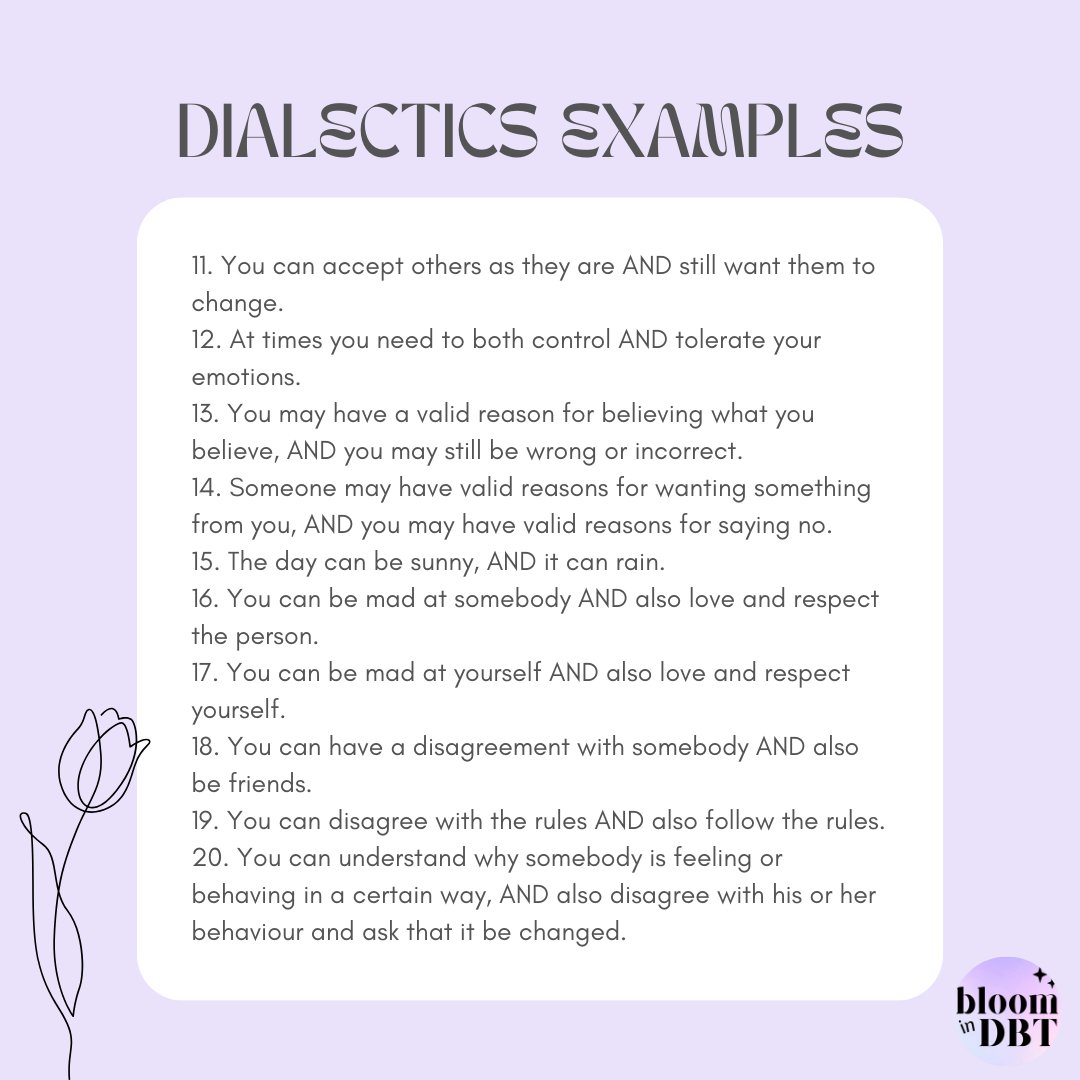
You can learn more in my previous article on DBT dialectics, but here are a few quick dialectics examples as a refresher:
So, no, while we should send love to that inner version of ourselves that feels the most safe only holding one emotion at a time, we definitely don’t have to be one thing or another. We are the whole spectrum.
We can experience emotions as they come, in waves, without losing sight of that bigger picture. It just takes practice.
If you want more peer-support from a DBT angle, you can download my Little Guide To DBT Mindfulness Skills and Little Guide To DBT Interpersonal Effectiveness Skills over in the Bloom in DBT shop.
Or, browse around the blog for more free resources!
Lizzie 🤍

 Eliza Blooms