

If you like the idea of keeping a gratitude journal but regularly find yourself staring at a blank page thinking, OK, what am I actually supposed to write?, I’ve made something that might help.
I’ve just added The Gratitude Tracker to the Bloom in DBT shop.
It’s a downloadable, DBT-informed gratitude workbook designed to make keeping a gratitude diary a little easier, particularly when you’re not having a particularly easy time of things.
GET THE GRATITUDE TRACKER IN THE BLOOM IN DBT SHOP
I’ve written before about different ways to practise gratitude, including my post 65 Gratitude Diary Examples for Inspiration. That article is a good place to start if you’re looking for ideas or wondering what other people’s gratitude journals actually look like.
This new workbook is a little different.
Rather than giving you more examples to read, it’s somewhere to actually put your own gratitude practice into action.
Why I made a gratitude tracker
I like journaling, but I also know that a blank page isn’t always particularly helpful. When you’re feeling OK, you can probably think of plenty of things you’d like to write about. When you’re stressed, overwhelmed or having a rubbish day, being told to “write down five things you’re grateful for” can feel like yet another task you’re failing to keep up with.
That’s one of the reasons I wanted to make this gratitude diary template more flexible.
There are pages for daily journaling, but there is also a weekly tracker, prompts to use when your mind goes blank, space for monthly reflection and a gratitude letter. You can use the bits you like and ignore the rest. You don’t need to complete the whole workbook in order for it to be useful.
Gratitude doesn’t mean pretending everything is fine
This was probably the most important thing for me to include.
Gratitude gets talked about a lot in the mental health and wellbeing space, but sometimes it can come across as though the answer to feeling rubbish is simply to think more positively. That’s not really what I’m interested in. There are days when you’re grateful for your life and days when you’re struggling with it. Sometimes those things happen at the same time.
You can be having a terrible day and still appreciate the cup of tea someone made for you. You can be anxious and still notice that the sun is shining. You can be dealing with a difficult period of your recovery and still be proud that you used a coping skill instead of doing something that would have made things worse.
And on some days, gratitude might be as simple as being glad you got through it. The workbook deliberately makes room for this kind of gratitude. It describes gratitude as noticing what is good without ignoring pain, minimising what’s difficult or forcing yourself to feel happy.
That’s much more useful to me than pretending that every day is wonderful. That’s dialectics in action.
How gratitude fits with DBT
If you’ve been around Bloom in DBT for a while, you’ll know that I like looking at mental health tools through a practical DBT lens.
Gratitude actually fits quite nicely with a number of DBT skills.
The workbook explores connections with mindfulness, distress tolerance, emotion regulation and interpersonal effectiveness.
With mindfulness, you’re practising noticing what’s happening rather than automatically rushing past it. With distress tolerance, noticing something comforting isn’t about making the difficult thing disappear. It can simply help you get through the moment. With emotion regulation, regularly noticing positive experiences can become part of building more positive experiences into your life. And with interpersonal effectiveness, gratitude can help you notice the people who support you and the ways that connection matters.
None of this means gratitude replaces therapy, medication, professional support or the rest of your mental health toolkit. It’s simply another practice you can add to it.
What’s included in the Gratitude Tracker?
I wanted this to be something you could use in different ways, depending on what you need.
An inspiration page for blank-mind days
If you’ve ever opened a gratitude journal and thought, I genuinely cannot think of a single thing, you’ll probably appreciate this page. The workbook includes an Inspiration Menu with different categories to get you thinking, including daily comforts, food, relationships, recovery, DBT and mindfulness, home and safety, nature, work, creativity and second chances.
It’s not there to give you a list of things you should be grateful for. It’s just somewhere to look for ideas.
You might realise you’re grateful for something really ordinary that you’d normally overlook. That’s often where my own gratitude practice tends to go.
A daily gratitude diary card
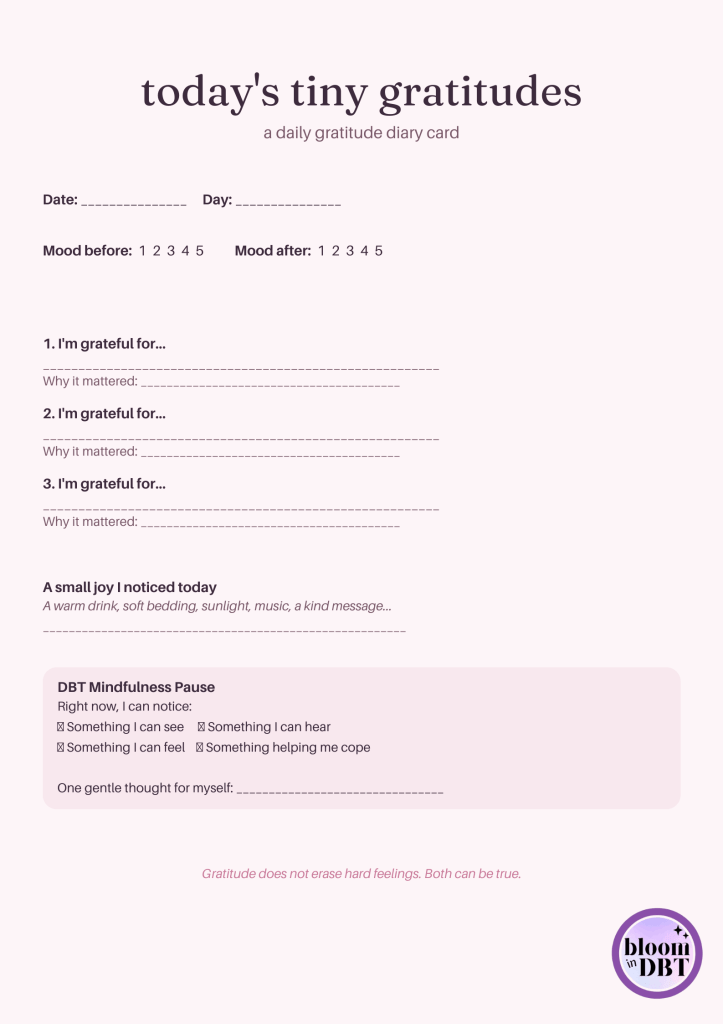
The main daily page gives you space for three things you’re grateful for, plus a little explanation of why each one mattered. There’s also room to record your mood before and after, write down a small joy from the day and complete a short DBT mindfulness pause. I included the “why it mattered” section because I think it makes a difference.
For example, instead of simply writing:
My friend.
You could write:
I’m grateful my friend checked in because I was having a difficult morning and talking to her helped me feel less alone.
It’s still a simple gratitude entry, but you’ve actually stopped to think about what made that moment meaningful. And if three things feels like too much on a particular day, you can write one. There really is no gratitude police coming to check your workbook.
A weekly gratitude diary template
The daily page isn’t going to suit everyone. Maybe you don’t want to journal every day. Maybe you prefer something quick. Maybe you’re more likely to stick with a weekly habit than another daily routine. The Weekly Tracker gives you a much simpler option.
You record one thing you’re grateful for each day, your mood and whether you practised a mindfulness check-in. At the end of the week, there are a few reflection questions to help you look back at what you’ve noticed. You can also look at your gratitude themes, including relationships, mental health and recovery, nature, creativity, food, work, peaceful moments, growth and safety.
Over time, that can be quite interesting to look back on. You might notice that the same things keep coming up. Or you might find that what you’re grateful for changes as your circumstances change.
30 gratitude prompts
There is also a page of 30 gratitude prompts for those times when you need a bit more direction.
They’re not all variations of “what are you grateful for today?”
Some ask you to think about things like what made you smile, something your body allowed you to do, someone you feel safe with, something that took courage, a skill that helps you cope, something you’ve survived, a boundary you’re proud of or something you’re looking forward to.
I’ve tried to keep these relevant to real life and recovery rather than making them feel like generic positivity prompts. You might not have an answer to every question. That’s fine. They’re there to give you somewhere to start.
A monthly gratitude reflection
If you enjoy looking back over your journaling, the monthly reflection gives you a chance to step back from the individual entries.
It asks about what you’re most grateful for, difficult moments you’ve got through, people who supported you, things you’re proud of, positive surprises and the DBT skills that helped during the month.
There’s also space to think about patterns in your gratitude. I think this is one of the more useful parts of keeping any kind of journal. You don’t always notice changes while they’re happening, but looking back can give you a slightly different perspective. You might realise that you’re coping with something differently. You might notice that certain people, routines or activities keep helping.
Or you might simply realise that you’ve made it through another month.
And there’s a gratitude letter, too
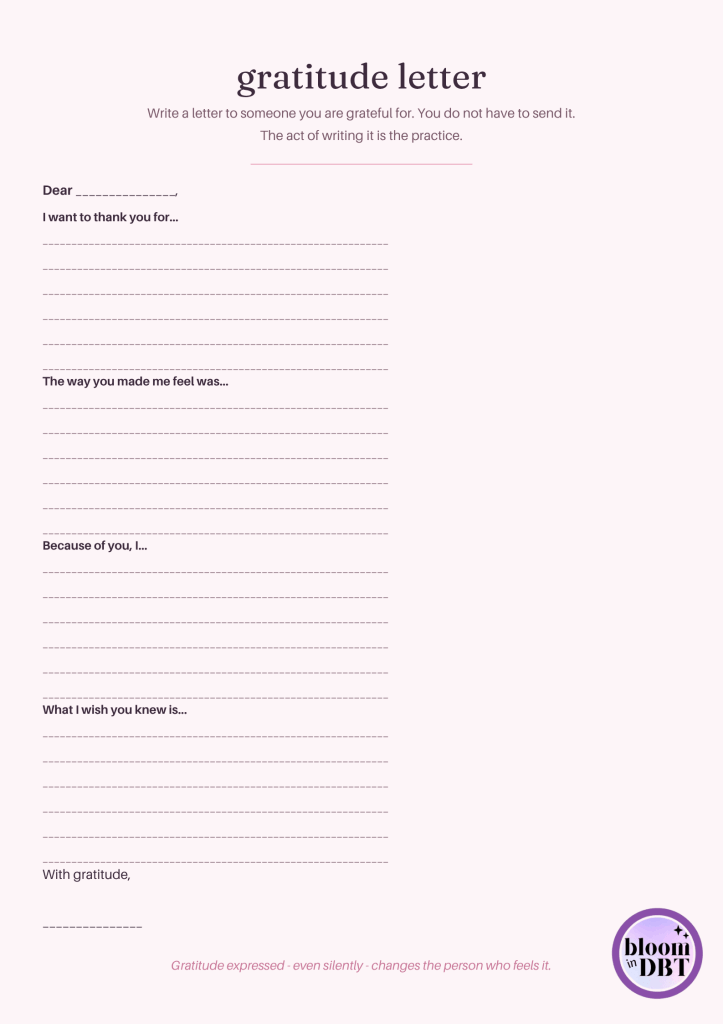
The final writing section is a Gratitude Letter.
You can write it to somebody you’re grateful for, whether you intend to give it to them or not. The prompts give you space to think about what you want to thank them for, how they made you feel and what you wish they knew. You don’t have to send it. Sometimes writing something down is enough.
How to use the gratitude diary download
There isn’t really a prescribed way to use this gratitude journal PDF. You could print the whole workbook and keep it in a folder. You could print individual pages as you need them. You could use the daily page for a few weeks and then switch to the weekly tracker. You could use the prompts when you’re stuck and completely ignore them when you know what you want to write.
The workbook itself suggests choosing your own pace. You don’t need to fill every page or use it every day. Even using it once a week is perfectly valid. Personally, I think that’s a much more realistic approach to journaling than deciding you’re going to write three pages every morning for the rest of your life and then feeling guilty when you inevitably don’t.
Download The Gratitude Tracker
So, if you’ve been looking for a gratitude journal or diary PDF download or a printable gratitude journal template, you can now find one in the Bloom in DBT shop.
DOWNLOAD THE GRATITUDE TRACKER FROM THE BLOOM IN DBT SHOP
And if you’re still at the stage of thinking, OK, but what on earth am I supposed to write in a gratitude journal?, have a read of my 65 Gratitude Diary Examples for Inspiration first.
Then come back here when you’re ready to start filling in your own.


1 thought on “Introducing the Gratitude Tracker: Downloadable gratitude journal PDF by Bloom in DBT”