

Why Does Shame Feel So Big?
Today has been a little bit of a rollercoaster for my nervous system.
It’s safe to say that out of all the emotions I experience, none hit me quite as viscerally as shame does. Even when its intensity absolutely does not fit the facts of the situation.
But why does shame feel so big? I think there are a few aspects to it.
Shame feels too big because I don’t know (or I am still learning) how to hold it in safety
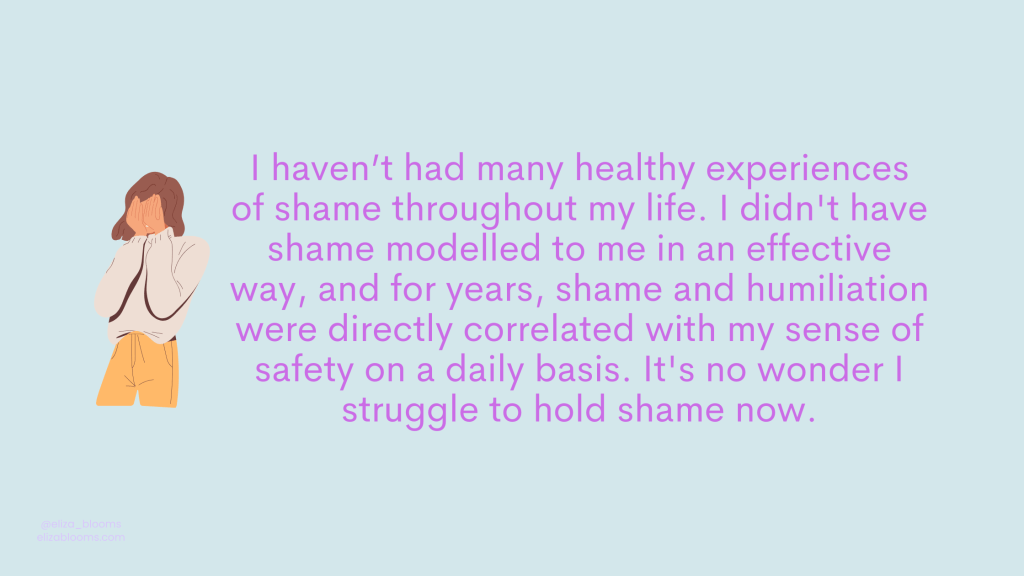
I haven’t experienced many healthy experiences of shame throughout my life, I haven’t had shame modelled to me in an effective way, and for years, shame and humiliation were directly correlated with my sense of safety on a daily basis.
Today, it wasn’t the event that happened as such that triggered me. That in itself was menial and nothing to fret over. It’s been more my internal reaction to the experience of shame, and my body and brain then jumping in to protect me from danger. Thanks team!
Either way, my fight or flight has been misfired and I have definitely slipped into emotion mind. I even just mistook a nice smile from my partner as him laughing at me.
Luckily our communication is wonderful, he’s incredibly supportive, and I’m no longer making choices to react ineffectively while feeling intense emotions. Five minutes later and I can see with full rationality how that was my emotional interpretation and not at all the facts of the situation.
My point is, if shame has been weaponised against you in the past, and you have only ever been taught to avoid it or numb it, then it makes sense for it to feel big when you experience it. This shit takes time to recover from. And that’s okay.
Shame feels big because I never allow myself to experience it
I know the feeling of being sick of hearing about exposure therapy. I’m sick of being told ‘avoiding it will only make it worse’ — which I’m sure some of my neurodivergent buddies out there will relate to.
But I’m going to say it anyway. Shame is terrifying because it’s not something I allow myself to experience. I have numbed, dissociated, avoided, or punished myself for the feeling of shame since I can remember, so it’s really no wonder it still feels so big.
Exploring these ideas has already helped me to feel more validated and more grounded in wise mind, but I know using some more DBT skills will be effective.
Living With Borderline Personality Disorder: Journal Prompts & More
Coping with shame using DBT skills
To try and put all of this slightly distressed rambling more mindfully, I know DBT skills are going to be useful here. So here I am typing them out in real-time. For more real-life DBT mindfulness journaling examples, prompts & mindfulness skills, take a look at my Little Guide To DBT Mindfulness E-Book.
Mindfulness of Emotion
- Humiliation: Sickness in pit of stomach, hot face, sweating.
- Shame: Shoulders tense and hunched forward, head down, tears behind eyes.
- Panic: Heart beating fast, racing thoughts, breathing faster.
Can I sit with these physical sensations? What do I notice?
Mindfulness of Thought
- Racing catastrophic judgments, assumptions and worry thoughts: “I’m embarrassing. Everyone is laughing at me. People are talking about me. Everything is going to fall apart. What if…?”
Can I sit, notice and label these thoughts for what they are? Can I remember times that I’ve had completely different thoughts?
Unglue Judgments By Checking Facts
- It is a judgment that ‘I’m embarrassing’ — I am feeling embarrassed is the fact.
- It is an assumption that anyone is laughing at me or that people are talking about me.
- It’s also catastrophising that threat — if people were talking about me or laughing at me over the event then that wouldn’t be a huge catastrophe.
Urges
- Hide, isolate, ignore, suppress, dissociate
- Be suspicious of intentions of people around me, be defensive
- Cry, self-criticise, ruminate
Skills Needed
Opposite Action
Hide? (Ineffective) Write a public blog post about it and make direct amends where needed. Message the person directly to bring it up with a light-hearted manner (this fits the situation)
Defensive? (Ineffective) STOP, breathe, half-smile.
Ruminate/self-criticise? (Ineffective) Distract by spending some time on my gratitude journal and writing out a few much-needed affirmations focusing on my current safety and safety of my emotions.
Cry? (Effective) Tears behind eyes and an urge to cry means that I need to move through my emotion instead of suppressing this. That is completely effective and I don’t need to act opposite to this urge.
Radical Acceptance
Can I accept it? It has happened now, I can’t change it. By acting opposite to my urges I can cope more effectively and that makes it easier to accept. Sitting with the physical sensations (Mindfulness of Emotion) and simply noticing and labelling my thoughts instead of attaching to them (Mindfulness of Emotion) also makes it easier to accept.
By accepting my emotions of shame and humiliation, I can get out of the ‘I need to change this’ thought spiral, experience it, and then try to move forward.
PLEASE — Reduce vulnerability by taking care of physical body
I am hungry! Time to grab some food and water and get a good night’s sleep to reduce my vulnerability to emotion mind tomorrow.
Sharing my shame
Every ounce of my body and brain is screaming to leave this journal entry in my Notion board hidden away from anybody’s eyes. But what is this blog here for if not this?
TL;DR: Shame is okay. Don’t hide from it.
You Might Also Like: The Little Guide To DBT Mindfulness Skills
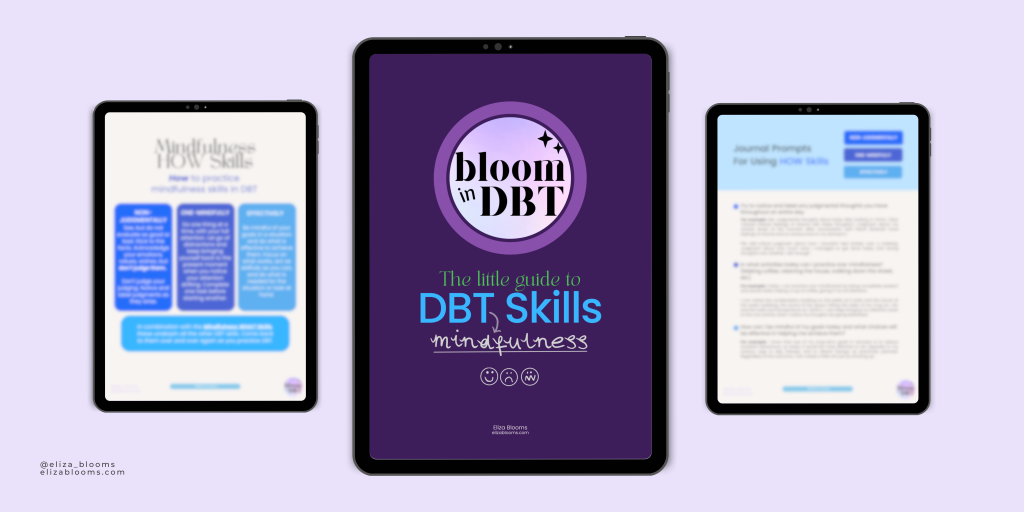
This 30 page digital e-book includes:
- 6 DBT Mindfulness Skill Graphics with easy-to-understand visual designs that help you remember them.
- 20+ Mindfulness Skill Journal Prompts with my own real-life example journal entries for each skill.
- Full page journal templates to help you easily combine and learn how to use the skills.
- Personal insights from someone who truly had their life saved by DBT – and how I went from zero DBT skills to daily skills use.
Available for instant download now


 Eliza Blooms
1 thought on “Why Does Shame Feel So Big?”