
DBT Mindfulness is one of four modules in the therapeutic approach developed by psychologist Marsha Linehan. DBT stands for Dialectical Behaviour Therapy, and Linehan developed it to help individuals regulate their emotions, reduce distress, and improve relationships with others.
For me, learning DBT Mindfulness Skills in therapy has been an invaluable tool for managing my emotions and staying present in the moment. I find that practising these regularly helps me stay grounded when I’m feeling overwhelmed or stressed out—and just more aware of how I’m feeling and what I need on a day-to-day basis.
So, in this blog post, I’m going to cover what DBT Mindfulness is, how it works, and some tips for getting started, as well as an overview of the core DBT Mindfulness Skills, and some journal prompts to help you use them. Hopefully these insights will help you gain a better understanding of DBT Mindfulness and learn some practical skills to apply in your own life.
Ready to start building your mindfulness skills? Download the Little Guide To DBT Mindfulness Skills today
What is mindfulness in DBT?
In the Dialectical Behaviour Therapy (DBT) approach, mindfulness is defined as:
- Intentionally living with awareness in the present moment. Waking up from automatic behaviours to participate and be present in our own lives.
- Without judging or rejecting the moment. Noticing consequences, discerning helpfulness and harmfulness—but letting go of evaluating, avoiding, suppressing, or blocking the present moment.
- Without attachment to the moment. Tending to the experience of each new moment, rather than ignoring the present by clinging to the past or grabbing for the future.
The DBT Mindfulness Module consists of particular skills that teach you how to be truly mindful in your daily life. Through practising these skills on a regular basis, you can develop greater insight into yourself and your environment so that you are better equipped to handle difficult situations with non-judgmental awareness, alignment with your true needs/values and calmness.
Additionally, through mindfulness you can enhance your empathy and communication with others while managing any strong emotional responses. By learning the various techniques associated with DBT Mindfulness Module you will be able to begin building a positive relationship with yourself as well as others around you.
What mindfulness is not…
I hear it time and time again when it comes to mindfulness or meditation practices: “I have too many thoughts to meditate” “I can’t quiet my mind for long enough” “There’s too much going on up there!”
I get it. But that’s not what mindfulness is. To clarify, mindfulness is not:
- Aiming to empty or clear your mind of all thoughts and worries
- Attempting to suppress ‘negative’ or uncomfortable emotions
- Trying to force yourself to feel ‘positive’ or pleasant emotions on demand.
Mindfulness instead is about bringing your attention fully to the present moment, the thoughts and emotions that arise, and noticing them without judgement or attachment. It’s about recognizing that our minds are active, and learning to observe the activity without getting lost in it. It is a practice of self-compassion and radical acceptance.
Through mindfulness we learn how to be gentle with ourselves and respond to difficult moments with kindness rather than criticism or avoidance. Or, to begin with, it can even be just about noticing these criticisms or urges to avoid—and maybe even having a laugh with our own thoughts.
Through practice, we can build an inner resource of strength that enables us to stay with negative emotions and not be overwhelmed or consumed by them.
Goals of mindfulness
- Experience reality as it is: Experience the reality of your connection to the universe, your essential “goodness,” and your essential validity.
- Reduce suffering & increase happiness: Reduce suffering, tension, and stress by bringing awareness to the present moment. Increase happiness by being more aware of it in the moment.
- Increase control of your mind: Stop letting your mind be in control of you. Reduce attachment to the demands of thoughts and urges.
What are the core DBT mindfulness skills?
There are 3 core DBT Mindfulness Skills, which are:
- Wise Mind
- WHAT Skills
- HOW Skills
In the sections below, I’ll outline each of these core skills to help you get to know the basics.
Wise Mind
DBT Wise Mind is the ability to connect with your inner wisdom and stay open-minded. It helps you stay in a balanced, compassionate state of mind by developing self-acceptance and connectedness.
At its core, Wise Mind is all about balance. Where is the wise, balanced point-of-view between your emotional mind and your rational mind. That’s the sweet spot.

WHAT Skills
So, what are the core mindfulness skills of DBT?
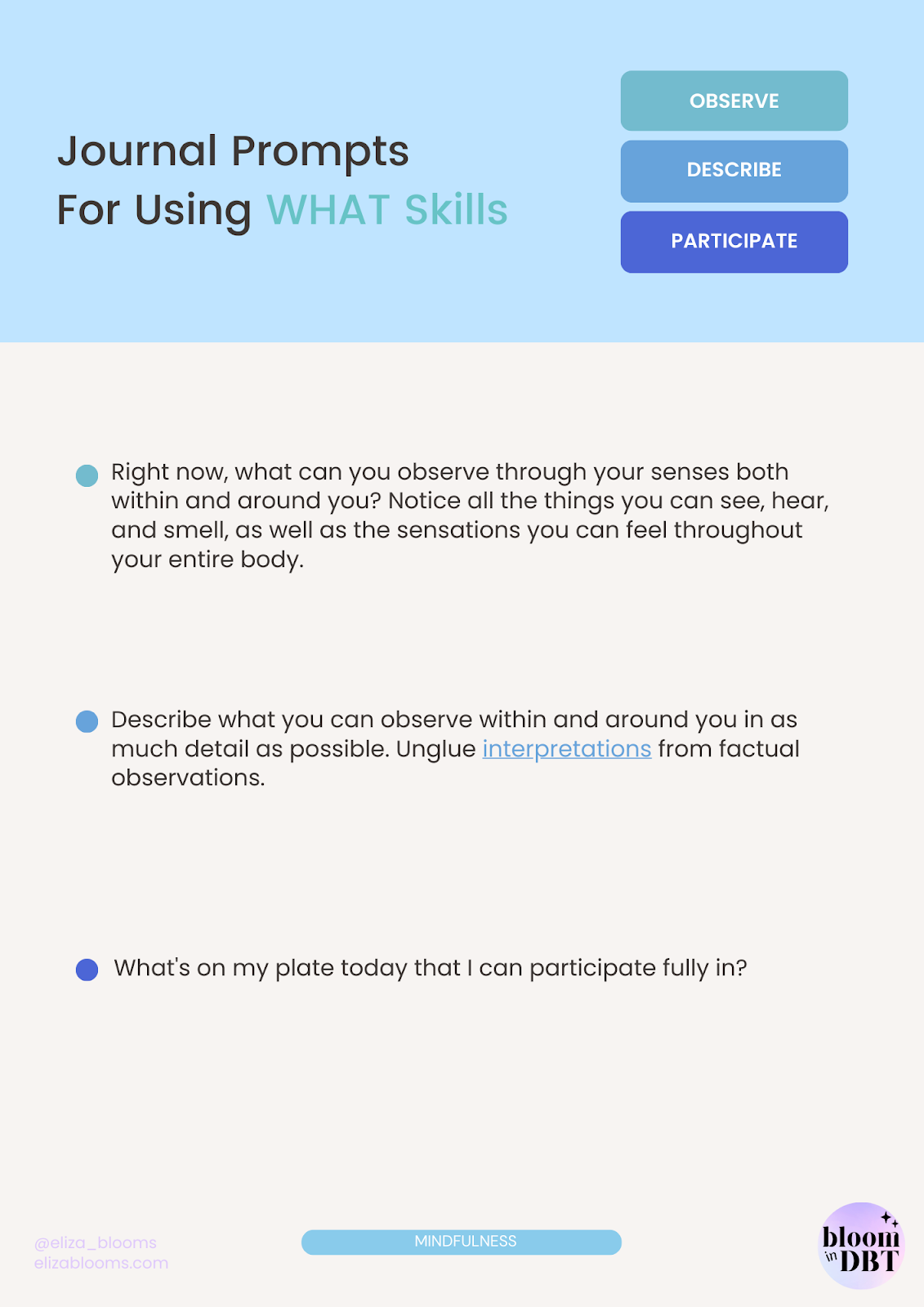
DBT WHAT Skills include:
- Observe: Take an observational stance, notice and observe your environment and yourself with a non-judgmental attitude.
- Describe: Recognize the facts without evaluation or interpretation.
- Participate: Take an active role in life by engaging fully in activities. Engage to be present (not just physically) but emotionally, mentally, and spiritually as well.
The WHAT skills allow us to cultivate a mindful attitude in our decision-making. We can use them to access the Wise Mind state of balance between emotion and reason.
HOW Skills
Now you know what the skills are, here’s how to practise them.
DBT HOW Skills include:
- Non-judgmentalness: This skill refers to the ability to accept reality for what it is, rather than judging it harshly. Notice judgments and assumptions and separate them from factual statements.
- Effectiveness: This skill helps us to take effective action in our lives. It involves doing what is effective and required for us to work towards our goals.
- One-Mindfulness: This skill helps us to focus on the present moment and stay with it, rather than getting distracted by thoughts of the past or worries about the future.
Core DBT Mindfulness Skills Summary
| Core DBT Mindfulness Skill | Details | Question/Journal Prompt |
| Wise Mind | Wise mind is the middle ground between our emotional minds and reasonable minds. | What are the tell-tale signs for me that I am in emotion mind? (Write a list) |
| What Skills | Observe, Describe, Participate | Right now, what can you observe through your senses both within and around you? |
| How Skills | Non-judgmentalness, Effectiveness, One-Mindfulness | Try to notice and label any judgmental thoughts you have throughout an entire day. |
Additional DBT mindfulness skills
Mindfulness of Emotion
Though technically taught under the Emotional Regulation module of DBT, Mindfulness of Emotion can also be considered a mindfulness skill. This skill involves becoming aware and accepting emotions as they arise, rather than trying to push them away or deny their presence.

Mindfulness of Thought
Similarly to Mindfulness of Emotion, Mindfulness of Thought is taught under the Emotional Regulation module of DBT and involves becoming aware of and accepting thoughts as they arise without judgement. Becoming mindful of our thoughts allows us to observe them objectively rather than being controlled by them or considering them as absolute truths.
Mindfulness of Others
Mindfulness of Others is taught under the Interpersonal Effectiveness module of DBT and involves being mindful of the thoughts, feelings, needs, and wants of people around us in order to effectively navigate interpersonal relationships.
It is important to remember that other people’s thoughts, feelings, needs, and wants are not necessarily absolute truths either; we can become aware of them without becoming attached or heavily influenced by them.
How to use DBT mindfulness skills

- Start in low emotional intensity situations.
- Know your why.
- Set aside time to practise (maybe with journaling!)
- Give it time!
DBT journaling
How to use DBT mindfulness journal prompts
Like I discussed in my living with BPD journal prompts blog guide, journaling can be an incredible tool for recovery, particularly hand-in-hand with DBT. To start using DBT mindfulness journal prompts, you can:
- Choose your journal prompts: You can download mine below!
- Start small: If you are feeling overwhelmed or anxious about starting your journaling practice, start with just 5-10 minutes of writing per day and build up from there. Set a timer if you feel like it.
- Ask yourself questions: Keeping an open mind and allowing yourself to explore, ask yourself “What is the emotion I am feeling right now? What does it remind me of? Can I stay with it without taking action and see what happens?
- Keep going! Seriously, even if you get stuck or feel like giving up – don’t. Continue to persevere and push through so that you can gain the benefits of DBT mindfulness journaling. The more you do it, the easier it will become!
Final thoughts…
Remember, the goal of mindfulness journaling is to become aware of your thoughts and feelings without judgement or expectation. This means staying in the present moment and observing without reacting. It also means giving yourself permission to explore whatever comes up during your process.
I really hope this blog has helped you learn the basics of the DBT mindfulness module!
Download the Little Guide To DBT Mindfulness Skills now
DBT Mindfulness Skills & Module FAQs
What are DBT mindfulness techniques?
DBT mindfulness techniques (or skills) are an important part of Dialectical Behavioral Therapy (DBT). This type of therapy is used to help people manage difficult emotions and situations, as well as improve their overall wellbeing. The main mindfulness skills taught in DBT include observing, describing, participating, non-judging, one-mindfully and efficiently. These techniques can be used both individually and with a therapist.
How do you practise mindfulness in DBT?
To practise mindfulness skills in DBT, you can try to be aware of your experiences and the present moment without judgement. You can observe and describe what you are feeling in the moment and name it out loud or write it down. Lastly, instead of reacting automatically with thoughts and behaviours that may not help you in this particular moment, mindfulness invites us to notice our choices, reactions, feelings and responses before we act.
What are the 4 core areas of DBT?
The 4 core areas (or modules) of DBT are mindfulness, emotional regulation, distress tolerance, and interpersonal effectiveness. Mindfulness is just one of the modules, but it is an important one as it provides the foundation for all of the others.

 Eliza Blooms
31 thoughts on “What is DBT Mindfulness? Module, Skills & Techniques”