

Dialectical Behavior Therapy (DBT) is a groundbreaking approach in mental health treatment, particularly for individuals struggling with Borderline Personality Disorder (BPD) and related conditions.
Its emphasis on mindfulness, distress tolerance, emotion regulation, and interpersonal effectiveness offers a comprehensive framework for navigating life’s challenges. However, a pressing question arises: Can DBT be effectively practised alone, without professional guidance?
In this article, we delve into the complexities of self-study in DBT, exploring its limitations, benefits, and the critical role of trained therapists in the journey toward healing and growth. I’ll also walk you through some of my own personal experiences with DBT, both professional training and self-study, to give you an idea of the difference between the two processes.
Understanding the Process of DBT Training
At the heart of DBT lies a set of core principles, modules and skills aimed at fostering emotional resilience and interpersonal skills. The four modules of DBT include:
- Mindfulness serves as the foundation of DBT, encouraging individuals to cultivate awareness of their thoughts, emotions, and behaviours without judgement.
- Distress tolerance equips individuals with strategies to cope with intense emotions and crisis situations.
- Emotion regulation offers tools for managing and modulating emotional responses.
- Interpersonal effectiveness focuses on improving communication, setting boundaries, and building healthy relationships.
When offered DBT as part of an NHS treatment plan, at least in my experience, these four core modules are studied in a two-hour weekly group session on Zoom. Almost like a training course or class, but with a touch of group therapy style sharing and discussion added into the mix.
(Note: I do not know if this specific timeline is standardised in the UK. Please do not rely upon this as what your specific treatment plan may look like. For reference, I am from West Yorkshire!)
You study skills, complete homework, practice skills, report back on experiences. You hear the experiences of others experiencing similar emotions, and are all guided together by your group instructors. In the year that I was in DBT training, I completed the training course of all four modules twice. That’s a lot of hours, and it’s a lot of skills.
The deeper work when in DBT is likely to come in your individual or 1-1 sessions. In addition to the two-hour weekly group, people in my local service were provided with 1 hour-per-week individual therapy sessions. For me, this had to take a more trauma-informed path, and I was lucky enough to land an incredible trauma-informed DBT practitioner who I will hold close to my heart forever for her support throughout that year of my life.
Individual sessions are about unpacking the current stressors and challenges holding you back from a life worth living, and unpacking how we are feeling as we navigate learning all of these new skills to help us recover. 1 hour a week of golden time—even if it required a cry and a meeting-free afternoon afterwards.
For me, a huge part of this process was learning how to actually want to recover. The direct guidance of my individual sessions taught me more than I can ever put into words.
The Limitations of DBT Self-Study
While self-study can provide valuable insights into DBT concepts and techniques, it cannot replace the guidance of a trained therapist. Without professional oversight, individuals do risk misinterpreting or misapplying DBT strategies, potentially exacerbating their emotional distress.
As such, the absence of trauma-informed care leaves individuals vulnerable to retraumatization, particularly when confronting past traumatic experiences. In my own experience, it is hard to feel safe after trauma. There were some things I was genuinely advised to not explore alone and to bring it to the session the first time I revisit it consciously. I needed that guidance to stay safe and effective in my processing, not drift off into dissociation or even potential episodes of self-harm.
As such, while self-study may offer a great foundation for and supplement to DBT training, it cannot replicate the nuanced support and personalised interventions provided by experienced therapists. Where professional DBT treatment is accessible, possible or available, steps towards it should be a first option.

So–Can I Do DBT By Myself?
I’ll go into my own experience and opinions later in this article, but to stick to the recommendations of authority bodies in the mental health space, here is what Mind Mental Health Charity has to say on the topic:
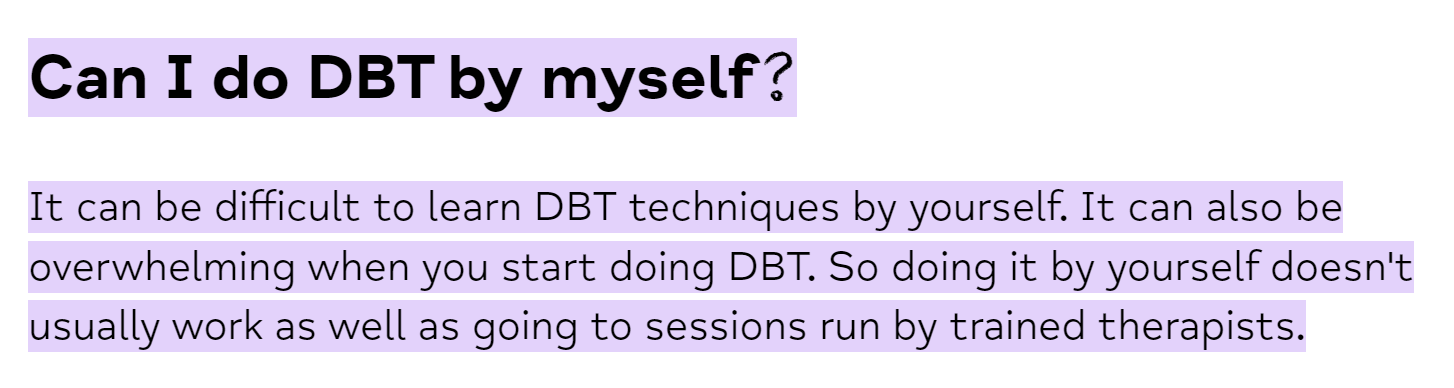
They go on to state that doing a formal course of DBT can help you:
- Stay motivated if you feel like giving up.
- Find situations where you can practise DBT skills.
- Feel supported and less alone, as others in the group are going through the same process.
Mind also recognises DBT self-help materials such as diary cards, exercises and behavioural analysis sheets can support individuals to work on their DBT training alongside a formal course, or after finishing one.
What Types of DBT Self-Study Can Be Done Individually?
Self-study resources, such as low-cost DBT ebooks, free blogs like this one and other online content, can serve as valuable supplements to formal therapy. They provide individuals with an opportunity to familiarise themselves with DBT concepts and techniques at their own pace.
You could also opt to buy the full official DBT Training Manual & Worksheets Manual, but the costs do unfortunately add up and it can be quite text-heavy and hard to break down/understand.
Another way to self-study DBT is by engaging with online communities and support groups. This allows individuals to connect with others on a similar journey, offering mutual support and encouragement. While these resources can enhance understanding and skill acquisition, they are most effective when used in conjunction with professional guidance.

The Role of a Trained Therapist
Trained therapists play a pivotal role in the successful implementation of DBT treatment. Through trauma-informed care, therapists create a safe and supportive environment for individuals to explore and process their emotions. Customised treatment plans ensure that interventions are tailored to meet the unique needs and circumstances of each client.
Moreover, therapists serve as mentors and guides, offering insight, feedback, and encouragement along the path to recovery from BPD or other emotional regulation problems. Their expertise and experience are invaluable assets in navigating the complexities of DBT therapy.
Accessing DBT in the UK
While professional training is going to be more effective than self-study, unfortunately, it’s not always realistic in a timely manner. I can only speak to my own experiences, and in the UK, accessing DBT therapy can pose significant challenges, including long waiting lists and limited availability.
Advocating for improved mental health services and funding is essential in addressing the systemic issues that contribute to treatment gaps. This scarcity of resources often leaves many UK residents with only unaffordable alternative options, such as private therapy or online mental health coaching programs.
The vast majority facing accessibility barriers to therapies in the UK, however, will go without any access to DBT skills at all. Many won’t even hear of this therapy or the world of good it could do for them, simply due to a lack of access. Which is why I will always advocate for self-study if anyone thinks they could find value in these skills.
No, self-study does not replace professional therapy interventions, especially with potentially life-threatening conditions like BPD. But it sure as hell doesn’t hurt, and being told you can’t access the therapy or learn the skills alone just feels like a stupid gatekeeping notion in my mind. Anyway…
Self-study of DBT gave me purpose for the entire time I was sat on a waiting list needing help. I started familiarising myself with the approach and the skills. I started reading books and blogs and listening to the voices of people that had been through the therapy.
The Value of Self-Study
As I’ve just discussed, despite its limitations, self-study holds inherent value as a supplement to formal therapy. By immersing oneself in DBT literature and resources, individuals can deepen their understanding of DBT concepts and techniques.
Journaling and note-taking, in particular, can serve as a powerful tool for self-reflection and emotional processing, complementing the work done in therapy sessions. In this realm, BPD journal prompts offer a structured framework for exploring thoughts, emotions, and behaviours, fostering insight and personal growth.
Final Thoughts
In conclusion, the complexities of DBT therapy require personalised interventions and trauma-informed care that only experienced professionals can provide. However, let’s be clear, self-study resources and alternative options can offer valuable and completely valid support for individuals facing barriers to accessing traditional therapy.
By embracing a holistic approach that integrates self-study with professional guidance, where access allows, individuals can embark on a journey of healing, growth, and self-discovery in their pursuit of emotional well-being.
Throughout my year in therapy, I crafted a guide to the core skills that underlie all of DBT: DBT Mindfulness Skills. My guide is only a few pounds/dollars, and goes beyond the basic clinical point of view, offering you a personalised guide enriched by real-life examples from my own journey with DBT and the core skills. This can support both your professional therapeutic intervention or your own DBT self-study.
Available for instant download today.


 Eliza Blooms
2 thoughts on “Can You Do DBT Alone? Limitations & Benefits of Self-Study”