
Navigating the complex realm of mental health treatment can be both daunting and overwhelming. As someone who is still navigating the journey of Borderline Personality Disorder (BPD) recovery, I truly found solace and transformation through a year-long Dialectical Behaviour Therapy (DBT) course.
While my journey did not lead me through formal Cognitive Behavioural Therapy (CBT), I am keen to explore and share insights into the distinctions between DBT and CBT, shedding light on the paths these two therapeutic approaches tread in the landscape of mental health, hopefully helping people get a better understanding of which approach might be right for them.
A quick reminder before we dive in that as I have only been through DBT, this piece gives general guidance on the differences between DBT and CBT, and only speaks to my personal experiences of DBT. I’m sure others have different experiences of both therapeutic approaches.
DBT vs CBT: Understanding the Basics
Cognitive Behavioural Therapy (CBT) and Dialectical Behaviour Therapy (DBT) stand out as two leading evidence-based psychotherapies, each offering distinct approaches to mental health treatment.
CBT is designed to identify, address, and modify maladaptive thought processes and behaviours. This therapeutic model places a strong emphasis on recognising and challenging negative cognitive patterns, paving the way for positive behavioural changes. Rooted in evidence-based practices, CBT equips individuals with practical tools to reshape their cognitive landscape, fostering healthier mental states.
On the other hand, DBT emerged as an extension of CBT, incorporating additional elements, originating from Eastern philosophies, for a more comprehensive approach. Developed by Dr. Marsha Linehan, DBT uniquely integrates mindfulness, distress tolerance, emotion regulation, and interpersonal relationship skills.
Unlike traditional CBT, DBT recognises the importance of acceptance and validation in tandem with change, providing individuals with a holistic framework to navigate cognitive and emotional challenges and cultivate healthier connections with others.
In essence, while CBT zeroes in on restructuring cognitive processes and behaviours, DBT enriches this foundation by incorporating crucial aspects of mindfulness, emotion regulation, and interpersonal effectiveness. Both therapies share the common goal of evidence-based efficacy, offering individuals valuable tools to enhance their mental well-being.
Understanding DBT: What is Dialectical Behaviour Therapy?
Dialectical Behaviour Therapy, pioneered by Dr. Marsha Linehan, has become a beacon of hope for many experiencing emotional dysregulation and intense mood swings associated with living with BPD. DBT operates on the principle of dialectics, finding a balance between acceptance and change, or emotion and rationality.
In my year-long DBT journey, I discovered a structured framework comprising four skill modules: DBT Mindfulness Skills, Interpersonal Effectiveness Skills, Emotion Regulation Skills, and Distress Tolerance Skills.
Mindfulness, the cornerstone of DBT, equipped me with the ability to stay present in the moment, fostering a non-judgmental awareness of my thoughts and feelings. This practice laid the foundation for the subsequent modules, enabling me to navigate interpersonal relationships, regulate overwhelming emotions, and tolerate distress without resorting to self-destructive behaviours.
The unique aspect of DBT lies in its incorporation of skills training groups alongside individual therapy sessions. These groups provide a supportive environment where individuals learn and practice coping mechanisms, share experiences, and receive guidance in a collaborative setting.
The transformative impact of DBT on my BPD recovery has been profound. The emphasis on acceptance, mindfulness, and practical skills not only empowered me to manage my emotional roller-coaster but also paved the way for a more balanced and fulfilling life.
I was lucky enough to have access to an incredible, trauma-informed DBT practitioner, who helped me navigate trauma work and integrate the DBT skills learnt in the skills training into my life now. The group sessions gave me a whole other incredible, safe space to learn the skills – like a therapy study group.

An Uncharted Territory: Cognitive Behavioural Therapy (CBT)
While I’ve had basic counselling, group counselling, private psychotherapy, and, of course, DBT has been my guiding light, the world of Cognitive Behavioural Therapy remains unexplored in my personal journey. CBT, developed by Dr. Aaron Beck, focuses on identifying and challenging negative thought patterns and behaviours. The goal is to reshape these patterns, leading to a more positive and adaptive mental state.
Despite not undergoing formal CBT, I have delved into some literature to grasp the fundamental differences between the two therapies. CBT seems to emphasise the restructuring of cognitive processes, targeting the root cause of negative emotions and behaviours.
In contrast, DBT places a strong emphasis on validation and acceptance, recognising the coexistence of change and acceptance in the journey towards mental well-being.
Comparing DBT and CBT
Philosophy and Approach
- DBT integrates acceptance and change, encouraging individuals to accept themselves and validate emotions while working towards positive behavioural transformation and cultivating a ‘life worth living’.
- CBT centers on identifying and modifying negative thought patterns and behaviours, with a primary focus on cognitive restructuring.
Skills & Techniques
In terms of skills and techniques, I can only really speak to the 4 core categories of skills included in DBT: Mindfulness, Emotional Regulation, Interpersonal Effectiveness and Distress Tolerance.
DBT Mindfulness
- DBT places mindfulness at its core, fostering acceptance and non-judgmental awareness.
- CBT incorporates mindfulness but with a more pronounced emphasis on cognitive restructuring.
DBT Emotion Regulation (and Radical Acceptance)
- DBT’s Emotion Regulation module equips individuals with practical skills to manage and regulate intense emotions.
- CBT addresses emotion regulation through the identification and modification of distorted thought patterns.
DBT Interpersonal Effectiveness
- Both DBT and CBT recognise the importance of interpersonal relationships but approach them differently.
- DBT emphasises effective communication and relationship skills, acknowledging the impact of relationships on emotional well-being.
- CBT focuses on changing maladaptive behaviours and thought patterns that may contribute to interpersonal challenges.
DBT Distress Tolerance
- DBT’s Distress Tolerance module provides individuals with skills to navigate crises without resorting to harmful behaviours.
- CBT may address distress tolerance but often places a stronger emphasis on altering the underlying cognitive processes.
Suitability & Relevant Mental Health Conditions
- DBT is particularly effective for individuals dealing with emotional dysregulation, intense mood swings, and conditions such as Borderline Personality Disorder (BPD). It is well-suited for those who struggle with self-destructive behaviours and challenges in interpersonal relationships.
- CBT is widely used for a range of mental health conditions, including anxiety disorders, depression, phobias, and obsessive-compulsive disorder (OCD). It is effective for individuals dealing with negative thought patterns that contribute to distressing emotions and behaviours.
Accessibility & Costs (UK)
- Access to DBT programs may vary, and availability might be limited in certain regions. In the UK, DBT may be available through the National Health Service (NHS) or private practitioners, and wait-lists and costs can vary.
- Access to CBT is more widely accessible within the NHS in the UK, and it may also be available through private therapists. Costs for CBT may vary, and availability can depend on the specific region and healthcare settings.
Timeline & Practicing
- DBT is often delivered in a structured format, usually involving a combination of individual therapy sessions and skills training groups. The timeline for DBT can vary, but it typically spans several months to a year, with regular sessions to reinforce and practice skills.
- CBT can be delivered in individual or group settings, and the duration of therapy may vary based on the specific needs of the individual. CBT is often considered a shorter-term therapy, with some individuals experiencing benefits in as few as 12 to 20 sessions.
Your Journey, Your Choice
Your personal experiences, challenges, and aspirations will all shape the fabric of your mental health journey. What worked wonders for one person might not necessarily be the perfect fit for another. It’s this understanding that underscores the importance of acknowledging the individual nature of mental health treatment.
As you navigate your therapeutic options, remember that your journey is yours to navigate. Whether it’s the holistic embrace of acceptance in DBT or the targeted precision of cognitive restructuring in CBT, the overarching goal is your mental well-being. What matters most is finding the path that aligns with your needs, resonates with your essence, and supports your growth towards resilience, self-discovery, and a life marked by fulfillment.
The journey to finding the right therapeutic fit often involves consultation and exploration. Engaging with mental health professionals, discussing your goals, and considering the specific challenges you face can illuminate the path forward. The nuanced expertise of a skilled therapist can guide you towards the modality that aligns most seamlessly with your unique narrative.
Closing Thoughts
In the realm of mental health, the choice between DBT and CBT is deeply personal and dependent on individual needs and preferences – as well as access. Having found DBT instrumental in my BPD recovery, I am immensely grateful for the transformative journey it has offered. While I may not have ventured into the terrain of formal CBT, understanding the fundamental distinctions between these therapeutic approaches provides valuable insights into the diverse paths available for mental health recovery.
Ultimately, whether one finds solace in the acceptance and change balance of DBT or the cognitive restructuring of CBT, the overarching goal is the same: fostering mental well-being and embracing a life marked by resilience, growth, and self-discovery.
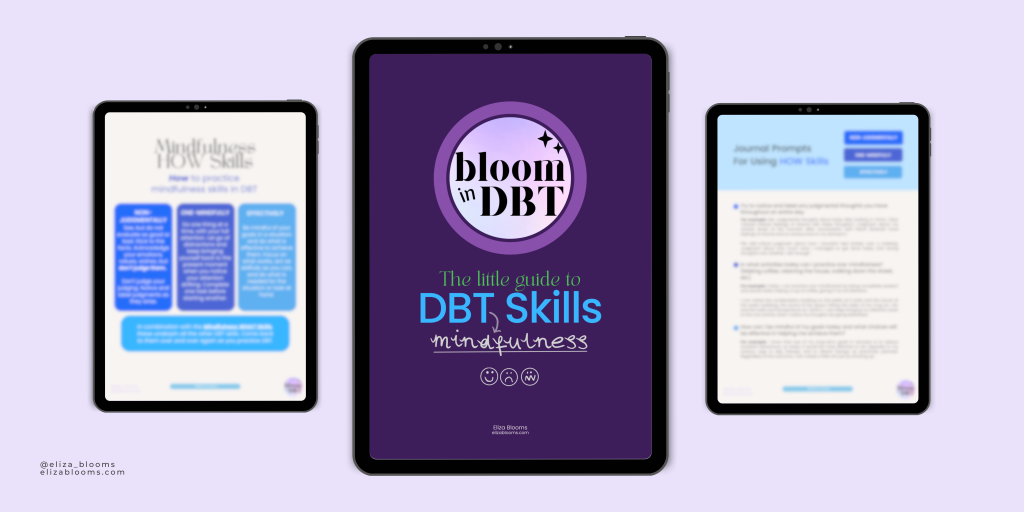
💡 Download my 30-page DBT Mindfulness Skills E-Book & Journaling Guide today for a more comprehensive guide to the DBT Mindfulness Skills.

 Eliza Blooms
Dear Eliza,
As a Personal Independent Counsellor myself, I was delighted to read your article and learn more about Dialectical Behaviour Therapy, which is not currently one of my specialisms.
Please take a look at my Counselling website and let me know if you’d like to open up a dialogue. I am always interested in improving my knowledge and skills.
https://tealightcounselling.com
There may be aspects of my own experience of counselling and psychotherapy that prove to be of benefit to you.
Best wishes,
Steven
LikeLike