

DBT HOW skills (Non-Judgmentalness, One-Mindfulness, and Effectiveness) can be really useful when it comes to handling life with intense emotions. They’re not just fancy words; they’re practical techniques aimed at helping you regulate your emotions and interact with the world around you in a more effective and less destructive way.
In this article, we’ll take a deep dive into each of these skills, exploring how they work and why they matter.
What are DBT HOW skills?
DBT HOW skills are taught as part of the DBT mindfulness module. This module is one of the four core pillars of Dialectical Behaviour Therapy (DBT), a therapeutic approach developed by Dr. Marsha M. Linehan.
The HOW skills are so named because they are “how” we practice mindfulness in daily life. Mindfulness HOW skills go hand in hand with Mindfulness WHAT skills, which are “what” we do when we practice mindfulness.
Both sets of skills help us navigate life’s complexities with more resilience and self-awareness.
How to practice mindfulness in DBT (DBT HOW skills)

Non-judgmentally
Noticing thoughts, feelings, and experiences without attaching judgement is the cornerstone of practicing mindfulness in DBT. It involves observing the present moment without evaluating it. By letting go of the impulse to judge, individuals can cultivate more acceptance of how things actually are, which is the best foundation for emotional regulation.
Part of this skill includes to not judge our judging – which sounds convoluted but, hear me out… We talk so much about non-judgmentalness in DBT, but most of us are there because we are very much used to living in our judgments and assumptions, away from checking facts. So, it might be hard to be totally “non-judgmental”.
The trick is to use your mindfulness skills to notice the judgments. For example: “I’m noticing a lot of judgments and resistance to this. Can I check some facts out before impulsively reacting?” This helps us pause judgment spirals – if we’re prone to that kind of thing. (I absolutely am.)
One-mindfully
Practicing mindfulness in DBT also entails the skill of engaging fully in the present moment, directing our attention to a single task or experience at a time. Multitasking dilutes focus and diminishes mindfulness in our activities. By immersing oneself completely in each moment and experience, individuals enhance their ability to experience life fully.
For example, eating your lunch without scrolling through your phone, instead focusing on the sensations and flavours of each bite, helps nudge you towards being grounded and present in the moment. One-mindfulness is about giving yourself permission to focus on just this: just this bite of food, just this yoga stretch, just this unpleasant emotion, just this breath. It helps regulate emotional overwhelm by narrowing our attention and cutting down the static of a thousand racing thoughts.
It’s especially helpful when emotions feel chaotic. Slowing down to be one-mindful with a cup of tea or your breathing gives the nervous system a moment to recalibrate. It can feel uncomfortable at first, but that discomfort is also development. You’re training yourself to stay present instead of escape.
Effectively
Effectiveness in mindfulness involves prioritising actions that align with our personal goals and values. It requires us to evaluate how effective our behaviours and actions are towards achieving our own desired outcomes. By adopting a simple and strategic approach to mindfulness like this, we can gently nudge ourselves towards our goals even when emotions are high. We can build the skill of noticing whether our urges and impulses are ineffective, which simply means not aligned with our goals or values. Again, we don’t need to judge this.
Aligning what’s effective for us with our personal values and goals takes us away from “right” and “wrong” and into a less judgmental frame of mind. An effective action might be walking away from an argument to cool off, even though your pride wants to get the last word in. Or it might be validating someone else’s feelings, even if you think they’re overreacting, because your relationship matters more than being “right.”
Conversely, it might mean validating your own feelings and ending an unhealthy relationship, even if guilt or grief steps in at the last minute. What’s effective for you might not suit everyone else. That’s okay.
Why are mindfulness HOW skills important?
DBT HOW skills play a pivotal role in cultivating emotional resilience and fostering healthier interpersonal relationships. Understanding the rationale and benefits behind these skills is essential for their effective application in daily life.
Benefits of non-judgmentalness
- Letting go of judgement reduces inner turmoil and promotes a sense of peace.
- By accepting others without judgement, you build trust and connection in relationships.
- Non-judgmentalness encourages self-kindness and compassion, helping grow our self-esteem.
Benefits of one-mindfulness
- By concentrating on the present moment, you enhance focus and productivity.
- Immersing yourself in one task at a time reduces feelings of overwhelm and anxiety.
- Fully experiencing each moment increases appreciation for life’s simple pleasures.
Benefits of effectiveness
- Effectiveness skills help you identify and pursue goals with clarity and purpose.
- By prioritising effective communication strategies, you enhance your ability to express yourself assertively and empathetically.
- Effectiveness skills empower you to navigate conflicts constructively without sacrificing what’s meaningful and important to you.
Final tips for using DBT mindfulness HOW skills
- Set aside dedicated time each day for mindfulness practice.
- Engage in activities mindfully, focusing on sensations, thoughts, and emotions.
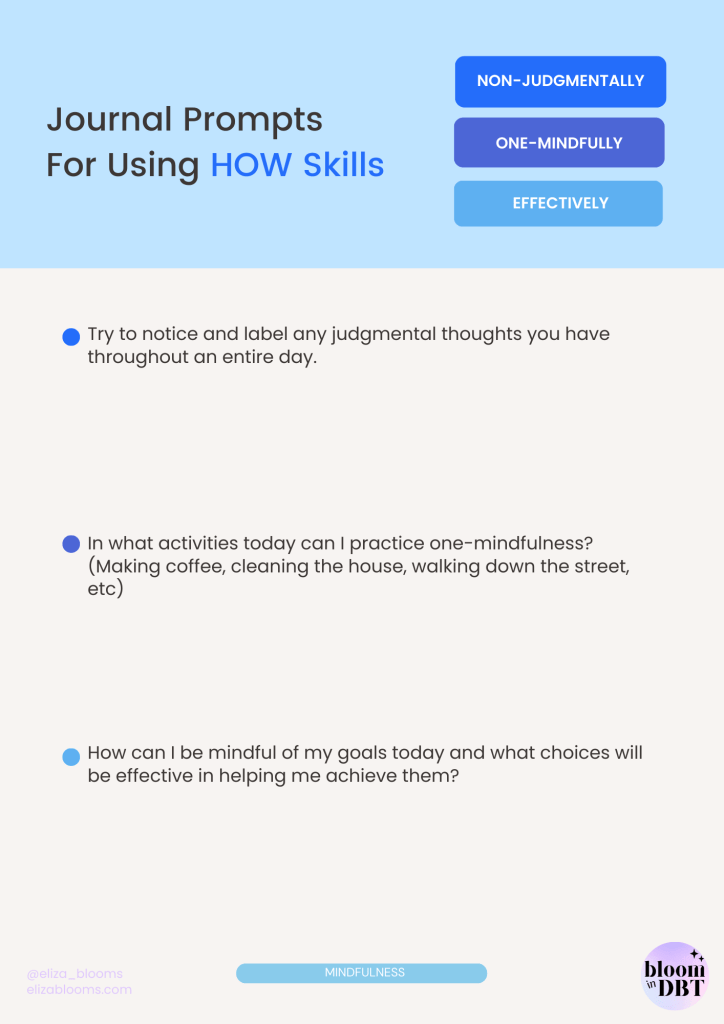
- Use DBT HOW skills journal prompts to reinforce non-judgmental attitudes towards yourself and others.
- Prioritise tasks based on their importance and impact on your goals.
- Practice active listening in conversations, fully engaging with the speaker’s words and emotions.
Closing Thoughts
Each step taken towards cultivating Non-Judgmentalness, One-Mindfulness, and Effectiveness contributes to a deeper understanding of oneself and the world around us. Moreover, embracing DBT HOW Skills extends beyond just the individual benefit; it also enriches interpersonal relationships and helps us build a more compassionate and empathetic society.
Ultimately, by integrating DBT HOW Skills into daily life bit by bit, we can navigate intense emotions that bit easier. With each mindful breath and intentional action, we move closer to a life defined by emotional balance, meaningful connections, and authentic fulfillment.
Get instant access to 20+ mindfulness journal prompts, templates, plus real example DBT skill journal entries in my Little Guide to DBT Mindfulness Skills. Available for download today.

 Eliza Blooms
4 thoughts on “DBT “HOW” Skills: How to Practice Mindfulness in DBT”