
Living with Borderline Personality Disorder: My Experience
In the run-up to a year since my diagnosis of Borderline Personality Disorder (BPD) was finalised, it is something that’s frequently been on my mind. I can honestly say it has been an absolute rollercoaster of a year, with more changes than I have ever experienced in one year before, and it’s all been pretty overwhelming.
With the lifestyle changes I’ve had to make to take better care of my mental health, the life I was living a couple of years ago seems worlds away from where I’m at now. One year on, I would say that living with borderline personality disorder is definitely still something I wouldn’t wish on anyone, but I’m learning to live with it the best I can.
I thought it might be helpful to journal some of the specific changes I’ve noticed or implemented since my diagnosis and how these changes have affected me and my mental health, especially in relation to my BPD recovery. This includes some handy journal prompts for BPD and a short guide on how to use journaling to help you manage Borderline Personality Disorder. Let’s get started!
Please be aware that this article may be some content relating to s*lf-harm, suic*de or extreme distress (but also recovery!) so if this may trigger you please continue with caution or take a look at some of my other content for now! 💞
Living with a Diagnosis
Once it sank in, living with a diagnosis was difficult. Although I was happy to have more of an action plan on how to manage my mental health, it felt a bit like a life-sentence, especially after some quick reading and internalising of ill-informed and stigma-ridden ‘resources’. I honestly felt like I was never going to be able to hold down a job, a stable relationship, become a mum, have financial stability, or any of the other ‘normal’ things adults do.
It was a scary time, especially since I had been open about my mental health journey so far. I felt an obligation to share this moment with people that have followed my mental health journey, but also the absolute fear that people would view me or treat me differently after my diagnosis.
Honestly, since then I have found that being open about my diagnosis has led me to a community of people online that have provided me with so many resources and so much support that I wouldn’t change anything now. Speaking up is the hard part, and the benefits usually far outweigh the negatives.
Living with Medication
There isn’t a medication that is made to treat borderline personality disorder — wouldn’t that be lovely — but you can treat some of the symptoms with a combination of different medications, including antidepressants, beta-blockers, and sometimes antipsychotics or mood stabilisers.
For me, Sertraline helps me with extreme low moods and depression and Propranolol helps with extreme anxiety and panic, but different medications work for different people. As I am waiting for an upcoming meeting with my local psychological services to get a care plan underway, I understand that I might be changed to a different combination of medications to see if any might be more effective, but I’ll update on this at a later date.
Another staple in my life these days is CBD (Cannabidiol). I find everyday CBD use, alongside everything else, significantly reduces my anxiety and feelings of extreme restlessness/emptiness.

Living Alcohol-Free
Probably the single most important decision I have ever made in my life, the choice to stop drinking has completely and utterly changed my life. It’s as simple as this: alcohol and BPD is a recipe for disaster. It’s not my place to say that every single person out there with BPD should never drink again, but I would seriously urge you to reconsider your relationship with alcohol if you think it could at all be a problem. Substance misuse or abuse is extremely common in borderlines and is not something to be ashamed of but also not something easy to acknowledge, try to be honest with yourself.
I spent so many years trying to work on my mental health with different treatments, all while going out and getting absolutely off my face multiple times a week and wondering why my mental health just got increasingly worse. Alcohol lowered my already significantly low impulse control, making it a game of Russian roulette every time I drank. One thing could go wrong and I would be in pieces and harming myself. I honestly believe that I would never really have had the potential for true recovery from my BPD with alcohol still in my life.
Now that I am out of the other side of the grip and significance alcohol has previously had on me and in my life, I can say I really believe it is the single most toxic but widely accepted influence on mental health I can think of, and cutting it out has done nothing but help me feel more in control when it comes to my BPD. Alcohol did nothing but enhance the severity and frequency of my BPD episodes and symptoms. I’m almost four months into my sobriety now and I’m so glad to be out of that terrifying and life-sucking cycle.
Living with Breakdowns
Even with alcohol out of my life, I still have episodes. For me, an episode presents itself as a major emotional breakdown: extreme emotional pain, crying for hours on end, dissociation, panic attacks, possible self-h*rm and suic*dal thoughts, intrusive and excruciating thoughts, extreme situational paranoia and anxiety, and more distressing symptoms.
Though I am still living with breakdowns, they are happening much less frequently for me now, and though I feel the way my brain works on a daily basis is definitely still affected by my BPD, the breakdown episodes are getting much more manageable. I have DBT skills in place that I try to utilise the best I can when I feel myself going, and though this will take practice to perfect, the basic tools are there to build on.
This also includes having a safety plan in place for emergency situations when extreme breakdowns happen: I.E. when suic*dal ideation or plans occur. An effective support system, a range of DBT skills and various resources to engage with helps me. I never know exactly what I am going to need in a certain moment, so I find it best to have loads of stuff to hand in case you ever need it.
Update for 2024
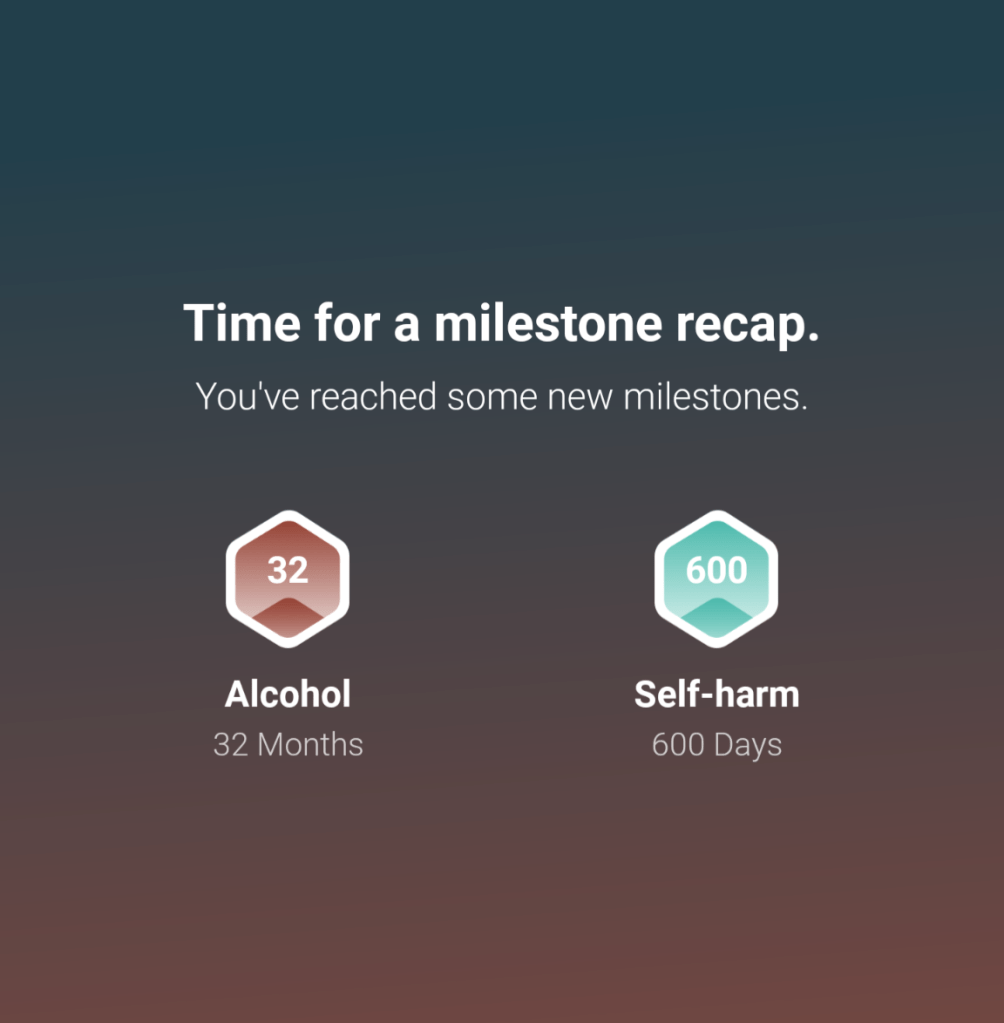
I first wrote this post back in August 2021, when I had been alcohol-free for around 4 months. I’m updating this at the start of 2024, and I’ve been alcohol-free for almost 3 years and self-h*rm free for over 18 months.
It’s funny how perspectives on recovery change. At the point in time of writing this original post, I truly thought that living with BPD meant living with breakdowns forever. Guess what? It doesn’t have to.
I no longer have, as I call it above, “episodes”. DBT helped me build the skills that stop it getting to that point now – and I also would no longer refer to the ways I had learnt to cope with trauma or distress in that way.
I have had 1 or 2 panic attacks in the last year or so, but I have been able to regulate my emotions, take space to feel my emotions, not invalidate myself, and honour my needs. I haven’t wanted to hurt myself in a long time. I just wanted to pop this little update in here, as although at one point this is what I thought life with BPD would be like, recovery brings so much unexpected and unimaginable joy.
Please, carry on.
Living Authentically
Thinking back, especially with things like drinking, I feel like I’ve lived a lot of my adult life in some sort of cognitive dissonance, learning and discussing the ins and outs of mental health but not fully embodying it. Since I’ve made the changes that came off the back of my borderline personality disorder diagnosis, I feel like I am my most true and authentic self, not a walking contradiction!
I have actually learnt what it feels like to feel happiness as a baseline emotion, something which I never thought I would feel. I’m living a life that works for me and my mental health, if that doesn’t look exactly like everyone else’s life then so fucking what? I am now living a life that feels authentically mine, and after a life of struggling with my identity and insecurities, I’m finally actually optimistic about my future. That feels good to acknowledge!
Living and Learning
Though I feel like my development over the last year has been insane, living with borderline personality disorder is still extremely difficult and recovery really isn’t linear. I have much more to learn through my own personal studies and DBT (Dialectical Behaviour Therapy) skills training, future therapies and further experience, but at least this is an honest start. We all live and learn and I (and anyone else struggling) will hopefully continue to do so to the fullest extent.
Journaling With Borderline Personality Disorder (BPD)
One key part of living with Borderline Personality Disorder (BPD) has been finding a safe space to express and identify my emotions. For me, that has been a mix between my therapist, my journaling, and now, my fiance.
The skills I learnt in Dialectical Behaviour Training (DBT) truly changed my life. To learn these skills, I used my journal. It took so much practice and commitment to the process even when I didn’t think I’d see results. But my journal gave me a truly safe space to explore even my emotional flashbacks to traumatic experiences once I learnt in therapy how to become mindful of the emotions and thoughts occurring.
Remember, healing trauma requires safety. So, while journaling can be such a great tool to aid your learning of skills to enable recovery from complex trauma, please know that you are worth both physical and psychological safety, and do what you can to create that for yourself alongside this deeper self-work.
Is Journaling Good For BPD?
Journaling can be a healing practice for many different avenues of mental health. In fact, one of the tools that I find the most helpful for coping with my BPD is journaling. I’ve found that writing about my thoughts and feelings can help me to make sense of them, work through them, and release them in a healthy way.
There are many different ways to journal, but for me, I find the most helpful prompts are ones that focus on specific aspects of my BPD. For example, I might write about a triggering event, an intense emotion I’m feeling, or a maladaptive coping mechanism I’m using.
Writing about these things can help me to see them from a different perspective, understand why I’m experiencing them, and find new and healthier ways to cope. If you’re living with BPD, I encourage you to give journaling a try!
How To Start a Journal For BPD
To get started, all you need is a notebook and a pen. You can also find BPD journal prompts online to help you get started. Once you have your supplies, choose a quiet place to write where you’ll be free from distractions.
Start by writing about whatever is on your mind. Don’t worry about editing or censoring yourself, just let the words flow. If you get stuck, you can always refer back to the BPD journal prompts for inspiration.
Once you’re finished, you can close your notebook and walk away. It’s important to remember that there is no right or wrong way to journal. The most important thing is that you’re expressing yourself in a healthy way.
Journal Prompts For Borderline Personality Disorder (BPD)
BPD journal prompts have been so useful for me in my recovery. Journal prompts for Borderline Personality Disorder can help me improve my grounding techniques, accept my emotions, and express myself without judgment. I honestly don’t know what I would do without my journal to help process the experiences I go through. If you have BPD, I highly recommend starting a journal. Here are some BPD journal prompts and ideas for journaling with BPD that might help:
- What are my self-destructive habits? List them and write out at least one new constructive coping mechanism for each.
- What are my triggers? Is there anything in my life that is consistently triggering me that I could let go of or change?
- List all the things that bring you joy. Look at it as a list of reasons to live.
- What was the triggering event that led to an intense emotional reaction?
- What emotions am I feeling right now, and why do I think I’m feeling them?
- Write about a time when you used a maladaptive coping mechanism or gave in to a destructive urge. What was I feeling at that moment? What could I have done instead?
- Try to observe the thoughts you are currently experiencing. Label them as they arise.
- Can I notice these physical sensations that come with these thoughts? Can I stay with those sensations? What do I notice?
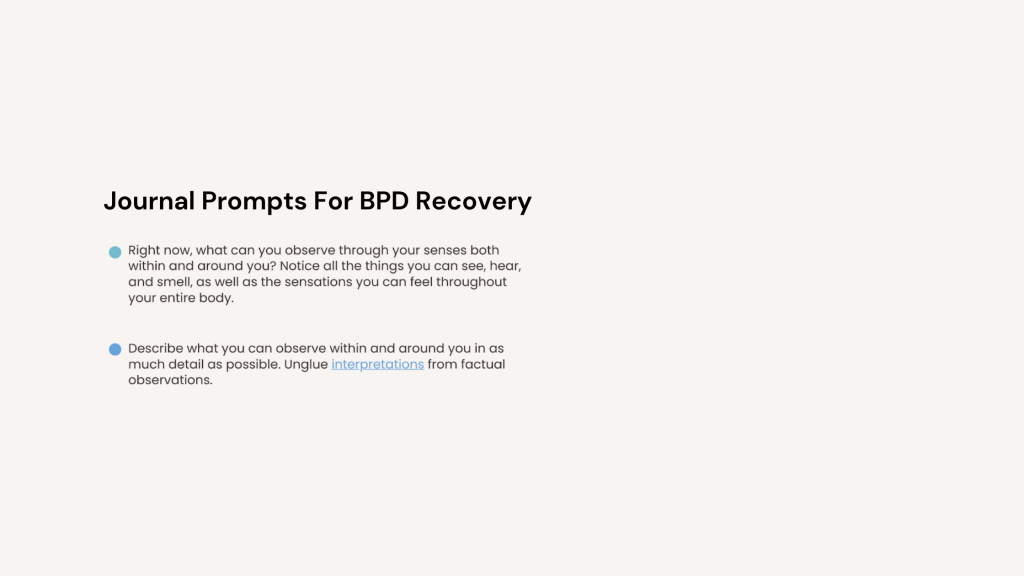
- Right now, what can you observe through your senses both within and around you? Notice all the things you can see, hear, and smell, as well as the sensations you can feel throughout your entire body.
DBT Journaling: How to journal for DBT
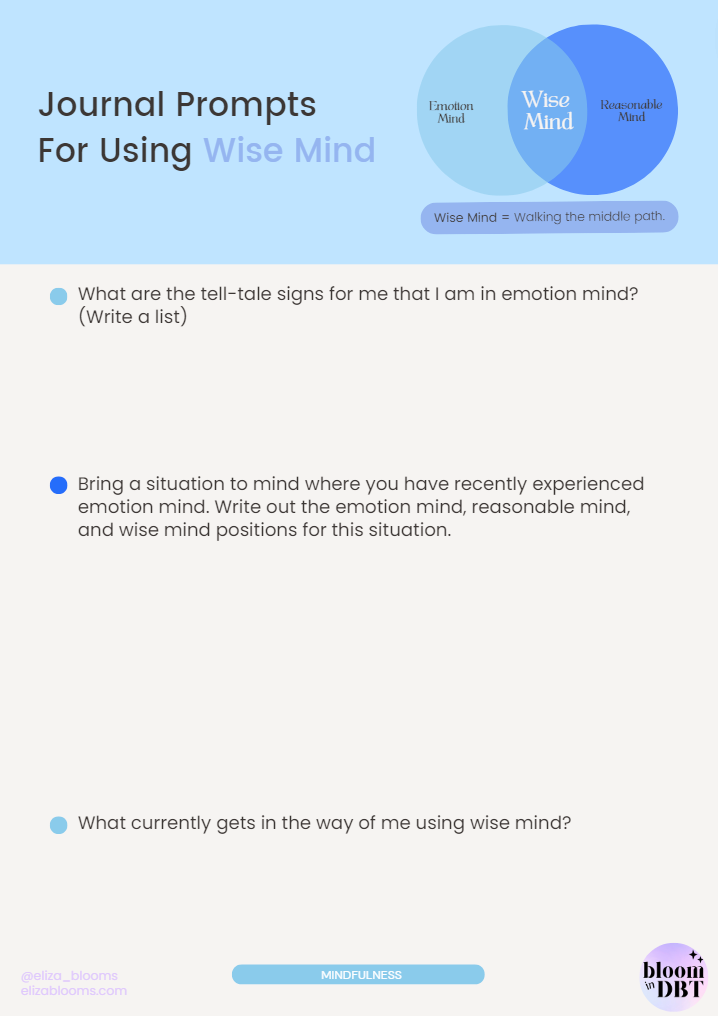
DBT Wise Mind Journal Prompts – Bloom in DBT
DBT (Dialectical Behaviour Therapy) is a specific type of therapy that is very effective in treating borderline personality disorder. If you manage to receive treatment for your BPD, DBT might be something that you are offered depending on your current circumstances. You can use your BPD journal to track your DBT progress, skills learned, and any homework assigned to you by your DBT therapist.
The key DBT skill categories that you might want to journal about include DBT Mindfulness, DBT Interpersonal Effectiveness, DBT Emotional Regulation and DBT Distress Tolerance. Using some DBT journal prompts for this could be extremely useful, so I’ve outlined a few ideas below.
If you’re not in DBT treatment, don’t worry! You can still use DBT journal prompts, alongside online resources, to explore the different skills and see how they apply to your life. Here are a few more useful therapy journal prompts to help manage your BPD:
- How did I use mindfulness today? How did I access my DBT Wise Mind today?
- What was a difficult situation that I handled well using interpersonal effectiveness skills?
- What emotions am I feeling and how can I regulate them in a healthy way?
- What was a crisis situation that I coped with using distress tolerance skills?
You can also use DBT mindfulness skills to help you keep a regular gratitude diary, something I find super helpful alongside all the heavier mental health journaling I do. Find some of my own personal gratitude journal examples today for more journaling inspiration.
Final Thoughts
I hope this has been some helpful insight into living with and managing borderline personality disorder. If you or someone you know is struggling, please don’t hesitate to reach out for help. There are many resources available and people who want to help. I’m not a mental health professional, but my DMs are always open over on my Recovery Instagram if you want to reach out for peer support. Peace and love.
You Might Like: The Little Guide to DBT Mindfulness Skills
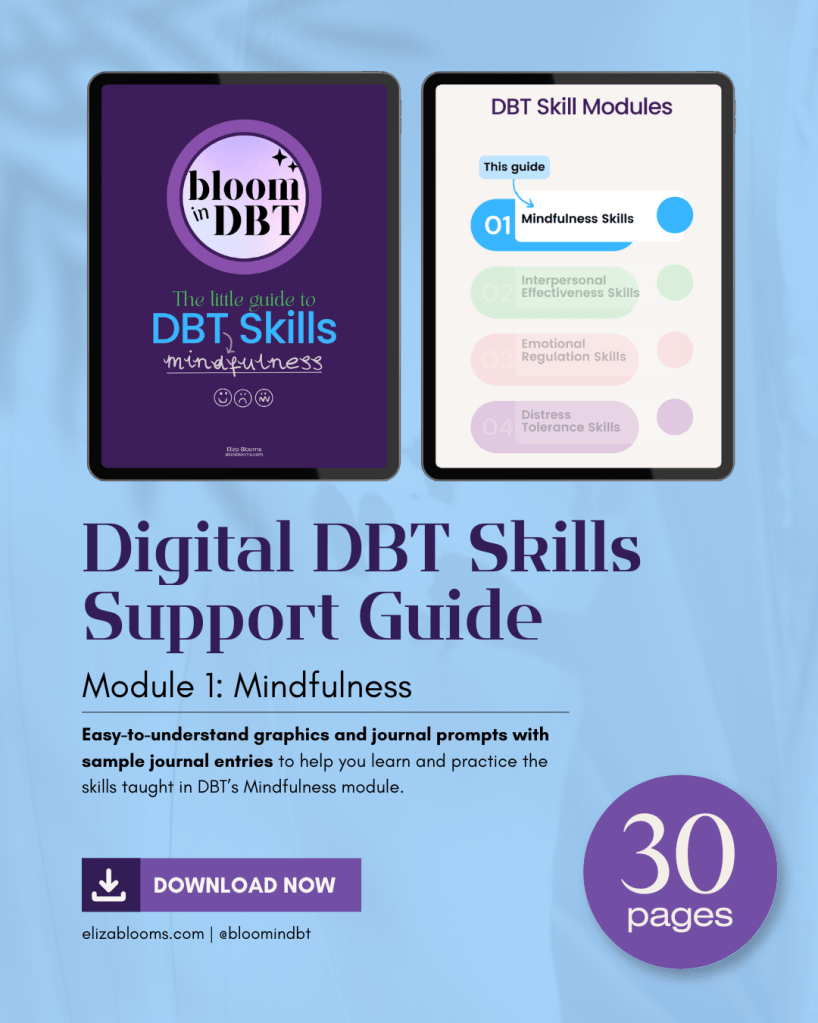
Discover the Power of DBT Mindfulness Skills with this 30-Page E-Book (Includes 20+ Journal Prompts, Recovery Entries & Templates!)
Learn the basics of DBT Mindfulness in a visually creative and accessible way. Journal your way through each of the skills with this 30-page digital workbook. I spent a year in DBT for 3 hours a week, and it absolutely changed (and saved) my life. During that time, I filled 2 journals and made a suite of digital graphics, journal prompts and note cards to help me learn and practice the skills in a way that worked for my chaotic brain. This was where my Bloom in DBT guides originated.
BPD Journaling FAQs
Is journaling good for people with BPD?
In my experience, journaling is absolutely good for people with BPD. In fact, journaling has been a game-changer in my BPD recovery journey. It provides a safe space to express and identify emotions, work through triggering events, and develop healthier coping mechanisms. Writing about thoughts and feelings helps make sense of them, offering a valuable tool for managing my BPD.
With journal prompts like the ones I’ve provided in this guide, you should have everything you need to get started with your BPD recovery journal. Remember, safety is crucial. Sometimes, distract skills may be a better short-term coping mechanism for extremely high levels of distress. You don’t always have to work it all out. Come back to it when your nervous system has had some time to regulate, or after some self-soothing.
What does a BPD episode look like?
A BPD “episode” will look different for every single person living with BPD. For me, a BPD episode used to manifest as a major emotional breakdown. It includes extreme emotional pain, prolonged crying, dissociation, panic attacks, self-destructive behaviours, intrusive thoughts, situational paranoia, and heightened anxiety. However, with time, support, and the right tools, these episodes can become more manageable, and recovery is possible.
What does BPD stand for?
BPD stands for Borderline Personality Disorder. It’s a mental health condition characterized by intense mood swings, unstable relationships, self-image issues, and impulsive, often self-destructive, behaviours. Living with BPD can be challenging, but with the right support and strategies, individuals can lead whole, safe, and fulfilling lives.
Do people with BPD recover?
Yes, people living with a diagnosis of BPD can absolutely recover. Recovery from BPD is a journey, and it’s not a linear process. I once believed that living with BPD meant enduring breakdowns forever, but my perspective has absolutely changed 3 years in. With the right resources, support, and commitment, recovery is not only possible but can bring unexpected levels of joy. Journaling, alongside therapies like DBT, has played a crucial role in my recovery, helping me navigate and understand my emotions better.

 Eliza Blooms
This is a very open and honest post. I am sure this will be helpful for others living with this condition as well as people who have loved ones who have the condition. Thank you for sharing.
Lauren
LikeLiked by 1 person
Thanks so much for this comment. It means a lot to know that my words reach people. Sending love.
LikeLike
I wouldn’t normally comment on this kind of thing, but this is the first time i’ve really looked for other peoples experience’s and everything you wrote i felt so much, i just ruined a great relationship and this really put the work i need to do into perspective. Thank you
LikeLiked by 1 person