
Developed by psychologist Marsha Linehan, DBT integrates cognitive-behavioural techniques with mindfulness and eastern principles, creating a holistic therapeutic approach. As DBT literally saved my life, writing educational content around it has become a huge priority for me.
So I have put together what I can in this brief guide. For more detailed explorations of each module, the specific skills and step-by-step guidance, you’ll find links throughout this piece to more of my educational DBT blogs. I hope you find some value in this!
Understanding DBT as a Therapeutic Approach
At its core, DBT seeks to empower individuals in regulating emotions, improving relationships, and navigating challenging situations with grace, authenticity, and fewer destructive habits. The approach supports individuals to discover a “life worth living” through the practice of mindfulness-based skills.
When compared with CBT, there are a few core similarities and differences that distinguish Dialectical Behaviour Therapy (DBT) as a unique therapeutic approach.
Both DBT and CBT share the common ground of being evidence-based therapies rooted in the cognitive-behavioural framework. However, DBT extends beyond the traditional CBT model by incorporating mindfulness principles and emphasising acceptance and validation of emotions.
DBT is also taught as a skills-based training, usually in groups, with the support of individual sessions with a DBT practitioner to support your personal integration of the skills throughout your time in DBT. While I was in DBT, I had both a 2 hour virtual skills training Zoom call and a 1 hour in-person therapy session every week for a year – so it is a pretty intensive (and effective) approach.
What are the 4 Modules of DBT?
This therapeutic approach is structured around four core modules, each addressing specific aspects crucial to emotional well-being:
- Mindfulness: The Foundation of DBT
- Interpersonal Effectiveness: Navigating Healthy Relationships with Skill
- Distress Tolerance: Managing Overwhelming & Distressing Emotions
- Emotional Regulation: Learning To Ride the Waves
Access to DBT in the UK
Accessing DBT services in the UK can be a variable experience depending on your location and the resources available within the National Health Service (NHS). The process typically begins with a referral from a healthcare provider, such as a General Practitioner (GP) or a mental health specialist.
However, it’s important to note that the availability of DBT within the NHS can vary greatly from region to region due to factors like funding and demand. This variance may result in extended waiting periods for assessments and commencement of treatment.
In my own journey, it took approximately a year from the initial referral by my psychiatrist to the commencement of DBT. During this time, there were several phone assessments with both core psychology and DBT practitioners, the development of a personalised care plan, and approximately eight months on a waiting list before beginning treatment.
DBT Module 1 — Mindfulness
DBT Mindfulness provides the foundation upon which all other skills and modules are built.
In the DBT context, mindfulness involves intentionally living with awareness in the present moment, observing thoughts and emotions without judgment. DBT Mindfulness acts as a guiding force, enhancing the effectiveness of other skills and promoting better decision-making and emotional regulation.
Core DBT Mindfulness Skills

Wise Mind
- Definition: The ability to connect with inner wisdom, finding the balanced point between emotional and rational minds.
- Application: Cultivating self-acceptance, staying open-minded, and approaching situations with balanced discernment.
- Wise Mind Spiritual Perspective: Wise Mind is a concept rooted in balancing the emotional and rational aspects of one’s mind. In the realm of spirituality, Wise Mind takes on profound significance, offering a pathway to connect with the sacred, the divine within, and the transcendent.
WHAT Skills
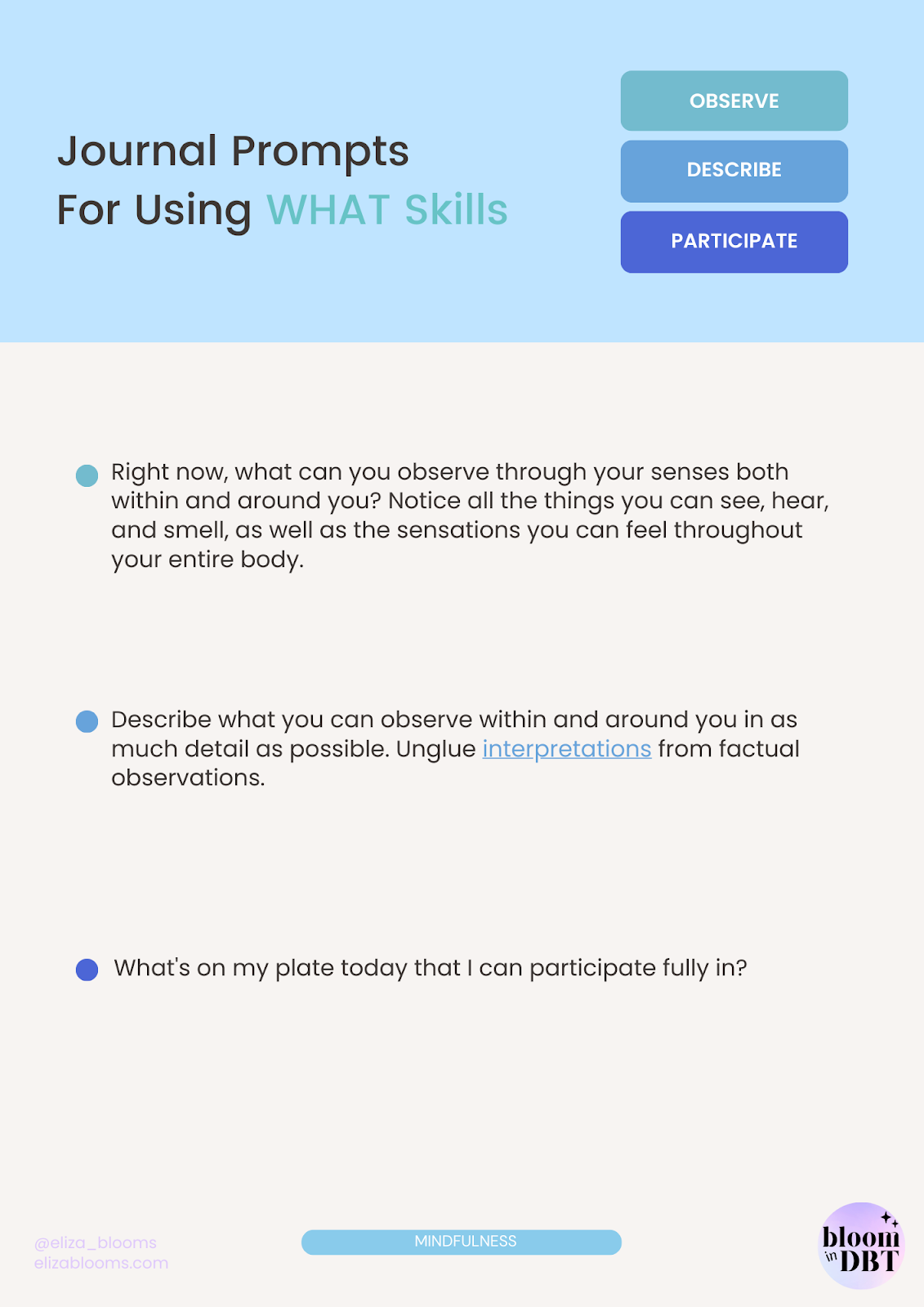
- Observe: Taking an observational stance, noticing and observing the environment and oneself without judgment.
- Describe: Labeling the facts without evaluation or interpretation.
- Participate: Taking an active role in life by fully engaging in activities—physically, emotionally, mentally, and spiritually.
HOW Skills
- Non-judgmentalness: Accepting reality with discernment but without judgment, noticing and separating judgments from factual statements.
- Effectiveness: Taking effective action in life by aligning action with goals and priorities.
- One-Mindfulness: Focusing fully on the present moment and current activity, avoiding distractions from past thoughts or future worries.
Additional DBT Mindfulness Skills

Mindfulness of Emotion
- Definition: Becoming aware and accepting of emotions as they arise, without pushing them away or denying their presence.
- Application: Observing emotions without judgment, allowing them to be present without attachment.
Mindfulness of Thought
- Definition: Awareness and acceptance of thoughts as they arise, without judgment or attachment.
- Application: Objectively observing and labeling thoughts, reducing their control, and avoiding automatic reactions.
Mindfulness of Others
- Definition: Being fully present and attuned to others’ thoughts, feelings, needs, and wants.
- Application: Fostering empathy, understanding, and connections by being mindful of the perspectives of those around you.
DBT Module 2 — DBT Interpersonal Effectiveness
DBT Interpersonal Effectiveness equips individuals with skills to navigate social interactions, communicate effectively, and maintain healthy relationships.
By focusing on three core goals (Objective Effectiveness, Relationship Effectiveness, and Self-Respect Effectiveness) and teaching you how to prioritise a goal for your current situation, DBT provides a roadmap for enhancing interpersonal skills and promoting overall well-being.
Core DBT Interpersonal Effectiveness Skills

- DEARMAN (Objective Effectiveness): A skillful script for achieving desired outcomes in specific situations.
- GIVE (Relationship Effectiveness): Focused on maintaining positive relationships with a gentle, interested, validating, and easy manner.
- FAST (Self-Respect Effectiveness): Emphasising fairness, avoiding excessive apologies, sticking to values, and being truthful.
Additional Interpersonal Effectiveness Skills
- THINK: A mindfulness skill promoting thoughtful, honest, intelligent, necessary, and kind communication.
- Mindfulness of Others: Being fully present and attuned to others’ emotions and perspectives.
- Ending Destructive Relationships: Recognising the importance of safe and supportive connections by ending harmful relationships.
DBT Module 3 — DBT Distress Tolerance
DBT Distress Tolerance, the third module, empowers individuals to cope with overwhelming emotions and crisis situations skillfully. By incorporating techniques like ACCEPTS, self-soothing, and IMPROVE, DBT provides practical tools for weathering emotional storms and building resilience.
Core DBT Distress Tolerance Skills
- TIPP: Using temperature, intense exercise, paced breathing, and paired muscle relaxation to reverse the firing of fight or flight responses and lower our levels of distress.
- ACCEPTS: Distraction techniques to shift focus from distressing emotions short-term.
- IMPROVE the Moment: Strategies to improve the current moment during distress.
- Self-Soothing Techniques: Engaging in comforting activities to build comfort and emotional resilience.

DBT Module 4 — DBT Emotional Regulation
DBT Emotional Regulation, the final module, focuses on understanding, tolerating, and modulating emotions effectively. By identifying and labeling emotions, understanding their function, and employing skills like opposite action, problem-solving, and accumulating positives, individuals can navigate their emotional landscape with purpose and resilience.
Core DBT Emotional Regulation Skills
- Check the Facts: Checking the accuracy of emotional interpretations.
- Opposite to Emotion Action (Opposite Action): Acting in a way opposite to the current emotion (when the emotion action is ineffective)
- Problem Solving: Addressing the source of emotional distress through practical problem-solving.
- Accumulating Positive Experiences (Short & Long-Term): Intentionally building positive experiences to counterbalance negative emotions.
Incorporating DBT into Daily Life
DBT is not confined to therapy sessions; it becomes a new way of life. A skill-set. By incorporating mindfulness, interpersonal effectiveness, distress tolerance, and emotional regulation skills into daily routines, individuals can experience a profound shift in their approach to emotions and relationships. The journey to emotional well-being becomes a continuous process of self-discovery, growth, and resilience building.
Using DBT skills when you really don’t want to
While it can be a beautiful journey, it is by no means linear. Sometimes, especially in those early days, you might find yourself not even wanting to use the skills. Here’s some advice for those times, from my own experience:
- Use that resistance: Once you have found the sensations of the resistance, notice the thoughts (and judgments) that are accompanying them. Label facts and judgments. Could you check the facts on those judgmental thoughts? Could you write a factual pros and cons list?
- Notice your judgments: Mindfulness really doesn’t have to be a “formal” practice. You can bring mindfulness to the current moment by noticing the resistance and how it feels in your body. What sensations do you feel? What emotions do you feel? What urges do you feel? Just notice them.
- Have your why to hand: Knowing your why is a great first step to using the skills. Having a clear and concise why to hand when you really need it is even more powerful. Whether it’s a note in your phone, a journal entry, or a post-it on your mirror, have it to hand.
- Utilise distress tolerance: If the present moment feels intolerable, and mindfulness to it is causing distress that you don’t yet have the emotional regulation skills to cope with, being able to non-judgmentally notice this is a great way to validate your current experience. In the short-term, until the distress has passed, you could try distress tolerance skills such as STOP, self-soothing, TIPP, or DISTRACT, and come back to mindfulness skills practice another time.
What Next?
Dialectical Behaviour Therapy shows just how effective skill-based approaches can be in the realm of mental health, particularly if you find emotional regulation tough. From the foundational mindfulness principles to the intricacies of navigating relationships, managing distress, and mastering emotions, DBT offers a roadmap for healing.
You Might Like: The Little Guide to DBT Mindfulness Skills
Throughout my year in therapy, I crafted a guide to the core skills that underlie all of DBT: DBT Mindfulness Skills. My guide is only a few pounds/dollars, and goes beyond the basic clinical point of view, offering you a personalised guide enriched by real-life examples from my own journey with DBT and the core skills. This can support both your professional therapeutic intervention or your own DBT self-study.

Download now
DBT (Dialectical Behaviour Therapy) FAQs
What is DBT and how does it work?
DBT, or Dialectical Behaviour Therapy, is a therapeutic approach developed by psychologist Marsha Linehan. It integrates cognitive-behavioral techniques with Eastern mindfulness principles. DBT helps individuals regulate emotions, reduce distress, and improve interpersonal relationships. It involves skill-building in areas like mindfulness, distress tolerance, emotion regulation, and interpersonal effectiveness. DBT
What are the 4 steps of DBT?
There are many steps involved in DBT skills training and ongoing practice of the skills, however the DBT approach is taught in four core modules. These are:
- Mindfulness: Cultivating awareness in the present moment, observing thoughts without judgment.
- Interpersonal Effectiveness: Developing skills for effective communication and healthy relationships.
- Distress Tolerance: Learning strategies to navigate crisis moments and distressing emotions.
- Emotional Regulation: Mastering skills to understand and manage intense emotions effectively.

 Eliza Blooms
26 thoughts on “A Brief Guide to DBT (Dialectical Behaviour Therapy)”